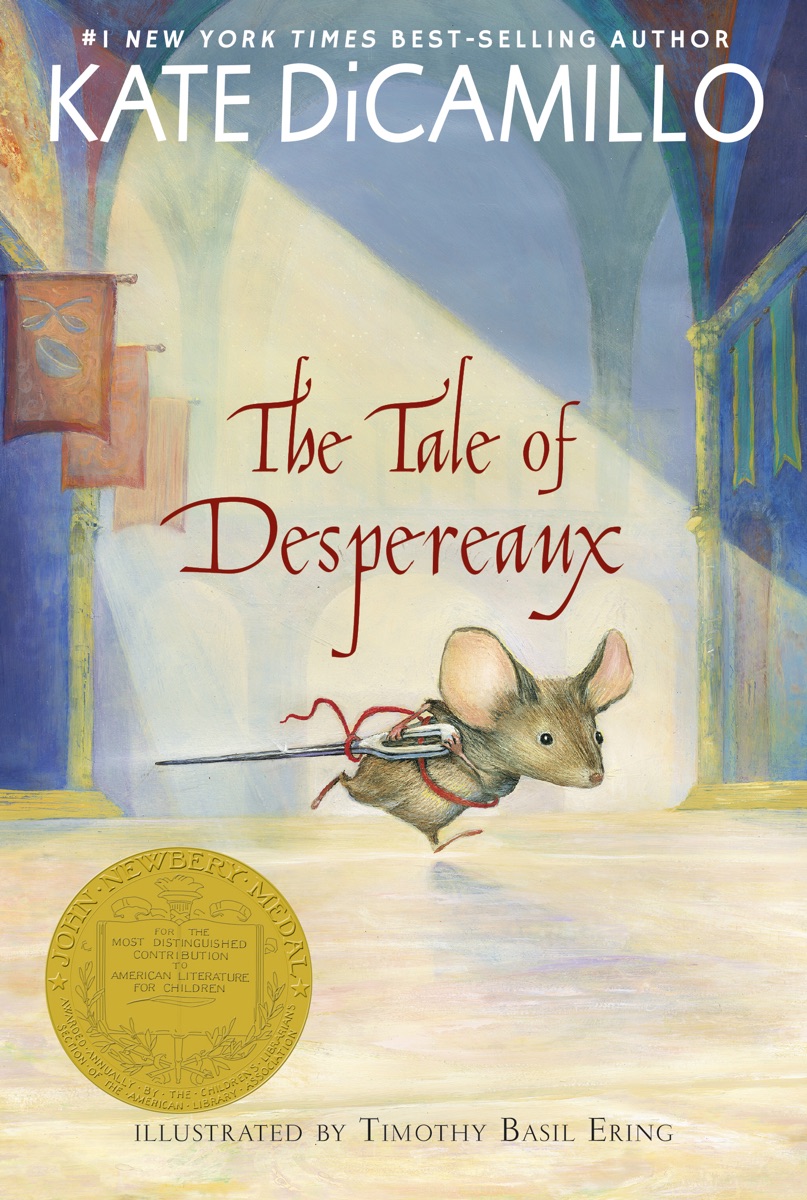
The Tale of Despereaux
by Kate DiCamillo
A Newbery Medal-winning fairy tale about a brave mouse, a bitter rat, and the transformative power of mercy
The story
Despereaux is a tiny mouse with enormous ears who breaks every rule of mouse society — he reads books, loves music, and falls hopelessly in love with a human princess. When his own community banishes him to the dungeon for this transgression, he must find the courage to face darkness, forgive betrayal, and prove that love and mercy are stronger than fear and revenge.
Age verdict
Best for ages 7-10, with strong read-aloud potential for younger children and enough literary depth to engage readers through age 12.
Our take
A literary fairy tale that parents and teachers treasure for its craft and moral depth, while kids appreciate its heart and voice more than its entertainment value
What stands out
Each audience's top 3 dimensions. Out of 30 scored per book.
Kids love
- Character voice Strong
Tier 3: Triangulated with City Spies and The Golem's Eye — Tale achieves exceptional voice distinctiveness across four characters identifiable without dialogue tags: Despereaux's poetic sincerity, Roscuro's bitter rhetoric, Mig's colloquial dialect ("Gor!"), Princess's logical kindness. Each voice is substantial and performable. Sits at 8 rather than 9 because Despereaux anchors the book; the other three are secondary.
- Heart-punch Strong
Despereaux's parental betrayal via community silence, heart-punch of exile, climactic mercy-over-revenge moment. Each peak is earned through sustained reader investment in character vulnerability across prior chapters. Sits at anchor exactly.
Parents love
- Writing quality Exceptional
Tier 3: Comparable to Illuminati — Newbery Medal-winning prose of genuine literary quality. Lyrical sentence construction, precise sensory detail, masterfully sustained narrator voice balancing warmth with philosophical depth. Light-darkness metaphor operates on literal, symbolic, and thematic levels simultaneously. Charlotte's Web represents the apex of prose musicality in children's literature; Tale sits at the 9 tier.
- Moral reasoning Exceptional
Tier 3: Triangulated with We'll Always Have Summer and Artemis Fowl — moral reasoning is exceptionally rich without clean answers. Questions: Should love breaking community rules be punished? Is villain shaped by suffering responsible for cruelty? Does vulnerable person enabling harm bear guilt? Is mercy weakness or profound strength? Tale sits at 9 tier rather than 10 because answers point toward forgiveness/mercy with narrative certainty.
Teachers love
- Read-aloud power Exceptional
Tier 3: Comparable to Sylvester and the Magic Pebble — exceptional read-aloud qualities. Narrator's direct address makes audience feel personally included. Multiple character voices distinctly performable. Short chapters fit class periods. Prose rhythm rewards vocal delivery. Sits at 9 tier rather than 10 because Interrupting Chicken is "built explicitly for performance"; Tale's read-aloud power emerges from voice and structure.
- Mentor text quality Exceptional
Tier 3: Comparable to 5 Worlds Book 1 — nearly every section demonstrates teachable craft: opening as hook construction, narrator's direct address as engagement technique, four-book structure as organizational strategy, light-darkness as sustained metaphor, moral climax as character-driven resolution. Sits at 9. Both texts work equally well as mentor text for different lessons.
✓ Perfect for
- • Readers ages 7-10 who appreciate beautiful language and stories that make them feel deeply. Ideal for families seeking a read-aloud with genuine moral complexity and multiple characters whose choices spark real conversation.
Not ideal for
Readers seeking fast-paced action, constant humor, or a single-perspective straightforward adventure — the multi-perspective fairy-tale structure requires patience with literary storytelling.
⚠ Heads up
At a glance
- Pages
- 272
- Chapters
- 47
- Words
- 32k
- Lexile
- 670L
- Difficulty
- Moderate
- POV
- Third Person Omniscient
- Illustration
- Heavy
- Published
- 2003
- Publisher
- Candlewick Press
- Illustrator
- Timothy Basil Ering
- ISBN
- 9780763680893
Mood & style
You'll know it worked when…
Most readers who connect with the narrator's voice in the first chapter will finish, drawn by short chapters and the promise of all four storylines converging; readers who prefer action-driven plots may stall during the middle sections.
More like this
Same genre, similar age range. Ranked by kid score.

Rump: The True Story of Rumpelstiltskin
by Liesl Shurtliff
Fairest of All (Whatever After #1)
by Sarah Mlynowski

Just So Stories
by Rudyard Kipling
Lon Po Po: A Red-Riding Hood Story from China
by Ed Young
Want more picks like this?
Get 5 hand-picked book reviews for your child's age — one email a month.