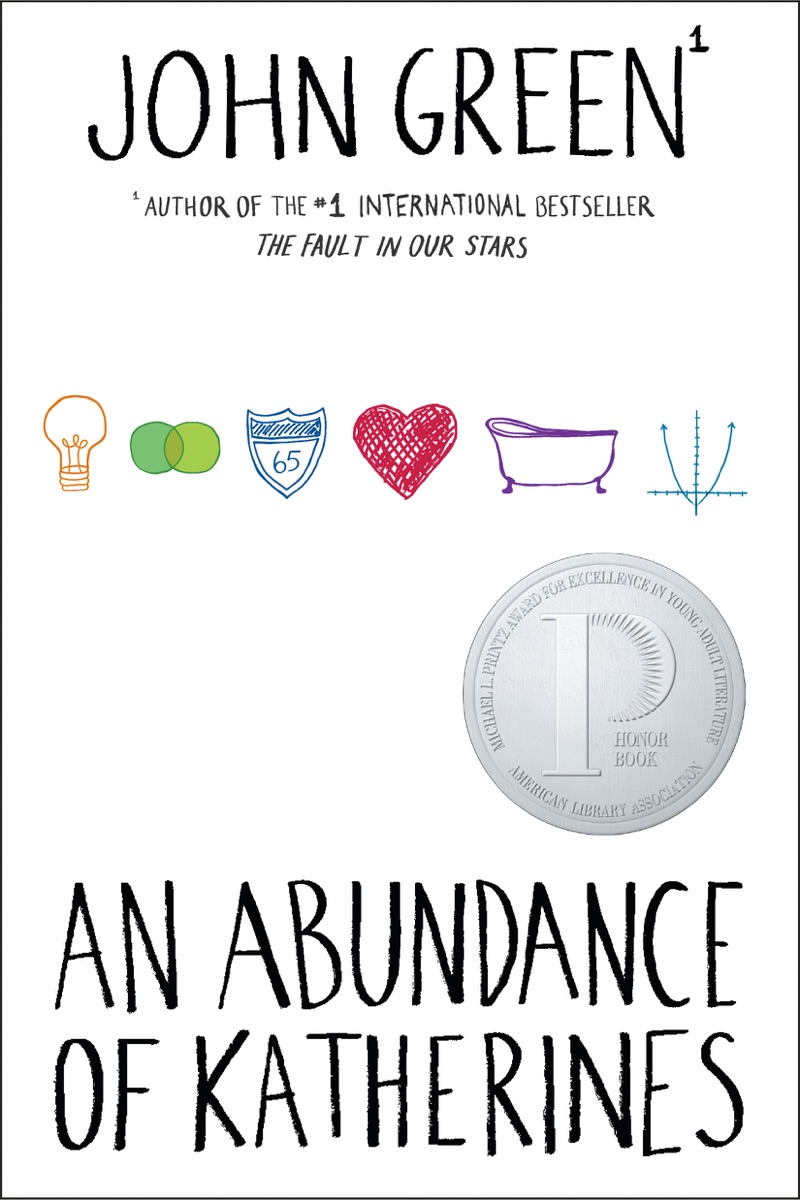
An Abundance of Katherines
by John Green
A brainy, funny road trip about a former child prodigy learning that being special isn't the same as mattering
The story
Colin Singleton, a recently graduated child prodigy who has been dumped by nineteen girls all named Katherine, embarks on a road trip with his wisecracking best friend Hassan. They end up in the small Tennessee town of Gutshot, where Colin attempts to create a mathematical theorem that can predict the course of any relationship while discovering that the most important things in life resist formula.
Age verdict
Best for ages 14-17. The crude humor, romantic references, and strong language place this firmly in older YA territory. Mature 12-13-year-olds who enjoy intellectual fiction can handle it, but the thematic resonance peaks with high-schoolers facing their own identity questions.
Our take
Literary YA — stronger for teachers and parents than for casual kid entertainment. High marks for writing quality, emotional sophistication, and cross-curricular value; lower on pure kid appeal metrics like plot unpredictability and gateway accessibility.
What stands out
Each audience's top 3 dimensions. Out of 30 scored per book.
Kids love
- Character voice Strong
Three distinct voices carry the book: Colin's verbose overthinking, Hassan's irreverent loyalty delivered through crude wit, and Lindsey's warm code-switching between small-town girl and sharp observer. A reader could identify untagged dialogue from any of the three.
- Laugh-out-loud Strong
Hassan is a genuine comedy engine — his rest-stop prayers, defaced hate-speech carvings, and frank commentary generate laughs every few pages. The humor ranges from situational absurdity to self-deprecating narration, landing more frequently than Harry Potter's seasoning humor but less relentlessly than dedicated comedy books.
Parents love
- Writing quality Strong
Printz Honor-level craft: Green's prose balances intellectual playfulness with emotional precision, using footnotes as a genuine narrative device rather than a gimmick. The voice is confident, the humor structurally integrated rather than decorative, and key emotional moments arrive through understated prose rather than melodrama.
- Emotional sophistication Strong
Green navigates complex emotional territory rarely addressed in YA: the shame of failed potential, the difference between being loved and feeling lovable, and the paradox of wanting to control the future out of fear rather than ambition. Colin's emotional blindspot — unable to see that people love him because he defines love as achievement — is sophisticated character psychology.
Teachers love
- Cross-curricular value Strong
Unusually strong math integration: the Theorem involves graphing, functions, and predictive modeling — a math teacher and ELA teacher can genuinely co-plan units. Geography and economics connect through Gutshot's factory-town decline. Religious studies benefit from Hassan's authentic Muslim representation. The appendix by mathematician Daniel Biss adds genuine mathematical rigor.
- Discussion fuel Strong
Every major theme generates genuine debate: Can human relationships be modeled mathematically? Is wanting to be remembered selfish or universal? Does Colin grow or just redirect his obsession? Students can disagree meaningfully about whether Colin's epiphany is earned or convenient, and whether the Theorem's failure proves or disproves his worldview.
✓ Perfect for
- • Intellectually curious teens who enjoy humor mixed with emotional depth
- • Readers who liked Looking for Alaska or Paper Towns
- • Teens interested in math, patterns, and big questions about identity
- • Young adults navigating post-graduation uncertainty about who they want to be
Not ideal for
Readers seeking fast-paced action, fantasy elements, or a straightforward romance. The introspective, math-heavy narration and crude humor may frustrate readers looking for a lighter or more plot-driven story.
⚠ Heads up
At a glance
- Pages
- 229
- Chapters
- 19
- Words
- 65k
- Lexile
- 890L
- Difficulty
- Moderate
- POV
- Third Person Limited
- Illustration
- Sparse
- Published
- 2006
Mood & style
You'll know it worked when…
A teen who finishes this book will likely want to discuss what 'mattering' means and whether you can really predict human behavior. They may also want to try anagramming names or graphing emotional arcs.
More like this
Same genre, similar age range. Ranked by kid score.

The Absolutely True Diary of a Part-Time Indian
by Sherman Alexie

On the Come Up
by Angie Thomas
Ace of Spades
by Faridah Àbíké-Íyímídé

Changers Book One: Drew
by T Cooper, Allison Glock-Cooper
Want more picks like this?
Get 5 hand-picked book reviews for your child's age — one email a month.