Is The Bad Guys Appropriate for 6-Year-Olds? The 21-Point Gap Every Parent Should Know
Is The Bad Guys right for your 6-year-old? KidsBookCheck scores show why kids are obsessed and parents are skeptical — and who is actually right.
The Verdict
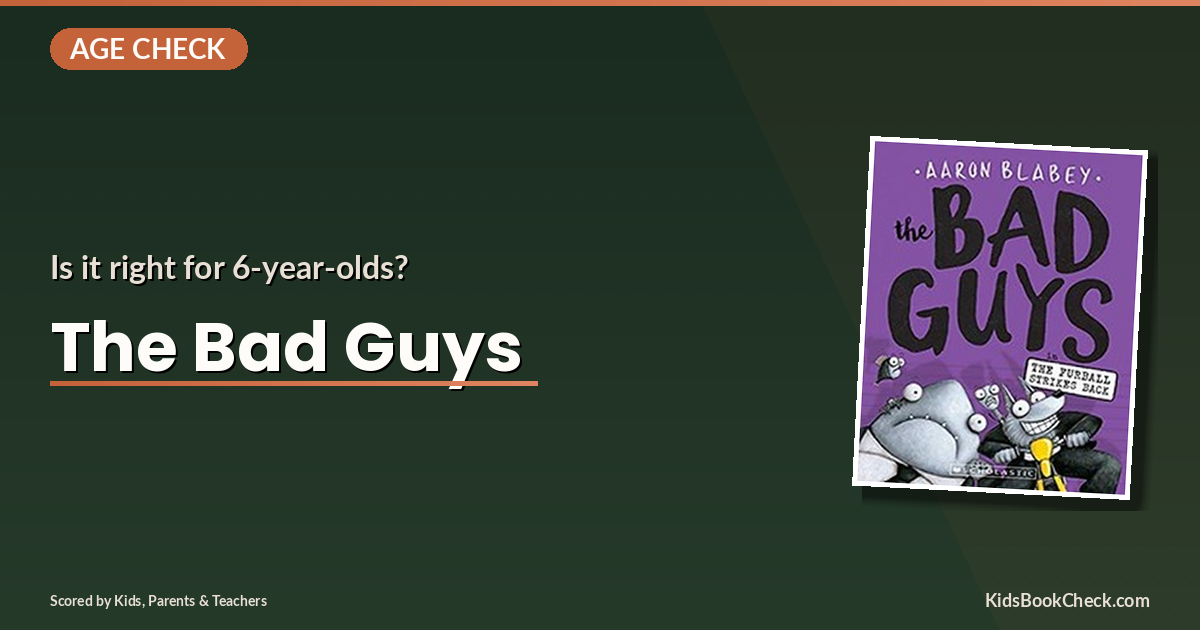
The Bad Guys series creates one of the biggest rating gaps KidsBookCheck has ever measured: 21 points kid-favored. Kids rate it 70, parents rate it 49, teachers land at 53. Composite score: 58.6. This gap is enormous and intentional—kids absolutely love this book, while parents and teachers are genuinely skeptical about the appeal.
Here’s what’s happening: The Bad Guys is 75% illustrations, features cartoon violence, villains as protagonists, and intentionally terrible behavior. Kids find this hilarious and liberating (finally, a book where the “bad” characters are the heroes). Parents worry it’s glorifying being mean. Teachers wonder about the literary value.
The honest answer: The Bad Guys is appropriate for most 6-year-olds in the read-aloud context, especially if you’re prepared to discuss what you’re reading. Independent reading works better at 7. The DreamWorks movie (2024) has sent every kid in America asking for these books, so this is worth understanding.
KidsBookCheck Scorecard
| Category | Score | Notes |
|---|---|---|
| Kid Appeal | 70 | Villains are heroes, silly humor, illustrations everywhere, no rules enforced |
| Parent Comfort | 49 | Mean characters, glorified bad behavior, minimal literary value |
| Teacher Recommendation | 53 | Engagement tool, but concerns about messaging and academic value |
| Composite Score | 58.6 | Recommended age 7+; 6 with adult co-reading & discussion |
Why the Massive Gap?
The Bad Guys breaks a core children’s book rule: protagonists should model good behavior. Instead, Aaron Blabey gives us a shark, snake, piranhas, and wolf who are trying to be good, but they mess up constantly and hilariously. The humor is derived from failure, poor decisions, and cartoon violence. Parents see a book celebrating meanness. Kids see a book saying: you can be weird, you can mess up, and you’re still valuable.
Learn how we evaluate books across different audiences—and why gaps this large actually tell us something important about the book’s positioning.
Reading Level Details
The Bad Guys is specifically designed for early readers with heavy illustration support:
| Metric | Level | Grade Band |
|---|---|---|
| Lexile Score | 260-550L (varies by title) | Grades K-2 |
| AR (Accelerated Reader) | 0.5-2.0 | Beginning reader graphic novel |
| Grade Reading Level | K-1.5 | Emergent to early reader |
| Recommended Reading Age | 6-9 | Illustrations support weak readers; humor engages strong readers |
The critical detail: About 75% of each page is illustration. Text occupies roughly 25% and consists of short sentences with simple vocabulary. This means a child who can’t yet read fluently can understand the story from pictures alone. Parents often underestimate this—they see “book” and assume it requires reading skill it actually doesn’t.
Age-by-Age Breakdown
Ages 5-6: The Movie-First Approach
Most 5-6 year olds can’t read The Bad Guys independently (the characters are too abstract, the humor requires understanding intentions). However, after watching the DreamWorks movie, they want the books. Here’s where it works: read it aloud, use the pictures to carry most of the story, and let them follow along. The illustrations are doing 75% of the work.
Success indicator: Your 6-year-old is excited by the movie and wants the books, and you’re willing to read them aloud and discuss the characters’ choices.
Caution: If your 6-year-old is anxious about “rules” or struggles with ambiguous morality, the characters’ behavior might confuse rather than delight them.
Ages 7-8: The Independent Sweet Spot
At 7-8, kids can read most of The Bad Guys independently. They understand that the characters are trying to be good even though they’re messing up. The humor about failure lands perfectly. The series is extensive (17+ books), so there’s always something new. This age group is the core audience and they read these books voraciously.
The fact that parents rate it at 49 while kids rate it at 70 means: your 7-year-old will probably want to read all 17 books, and you’ll probably spend the whole time mildly uncomfortable. That’s normal. It’s still okay.
Ages 9+: Extended Enjoyment
Older kids who’ve outgrown The Bad Guys usually graduate to more sophisticated humor (Percy Jackson, Diary of a Wimpy Kid). But some 9-10 year olds still reread these books because the humor is silly in a way they can appreciate. The main series is finite, so they’ll eventually move on, but the ride is long.
Parent Concerns: The Real Conversation
”These Characters Are Mean. Doesn’t This Celebrate Being Mean?”
The truth: The Bad Guys are genuinely mean sometimes. They bite people. They hurt feelings. They cause chaos. But here’s the crucial element: they feel bad about it and try to change. The entire series arc is about villains becoming heroes. They learn consequences, they develop friendships, they discover that being good feels better than being bad.
The distinction: This isn’t celebration of meanness. It’s a redemption narrative. Yes, the early books show bad behavior. But the series is about growth. Blabey is asking: what if the characters everyone feared actually had depth and capacity for change?
For kids: This is actually powerful. It says: you can be weird, you can mess up, and people can still love you and see your potential.
For parents worried about behavioral modeling: The Bad Guys works best when you read it aloud and talk about it. “The shark bit the goldfish. That hurt. Why do you think he felt bad afterward?” These conversations transform a silly book into something meaningful.
”There’s a Lot of Cartoon Violence”
True. Characters bite each other. They crash things. There’s food violence (eating people, sort of—it’s weird). Someone gets their head stuck. It’s cartoon violence—exaggerated, silly, nobody actually dies or bleeds—but it’s persistent.
Comparison: It’s equivalent to Road Runner cartoon violence. Funny, physical, not graphic, but definitely there. If your kid watches PG movies, they can handle this. If they get scared by cartoon slapstick, maybe wait.
”Is There Any Actual Reading Here?”
Yes, but minimal. Roughly 25% of the page is text. Short, simple sentences. Mostly dialogue. The story is told through illustration + text together. It’s a legitimate hybrid format, not “cheating” on reading, but it’s definitely picture-forward.
Translation: This isn’t a book that builds advanced reading skills. It’s a book that maintains engagement while reading skills are developing. That’s a different value, and it’s still a value.
”Should I Be Letting My Kid Read About Characters Who Don’t Follow Rules?”
Here’s the nuance: The Bad Guys characters don’t follow rules, but they experience consequences. That’s actually important. They cause chaos, things go wrong, and they have to fix it. That’s life, and it’s more realistic than every character being perfectly obedient.
If your house value is blind obedience: This book might conflict. Your kid might see the characters breaking rules and feel confused about whether rules matter. You know your parenting philosophy—adjust accordingly.
If your house value is critical thinking and natural consequences: This book teaches exactly that.
Comparison Table: Similar Books
| Book | Lexile | Age Range | Similarities | Key Difference |
|---|---|---|---|---|
| Dog Man (Dav Pilkey) | 400L | 6-10 | Silly humor, illustrations, comic format, rule-breaking protagonist | Dog Man is more absurdist; Bad Guys is more character-driven |
| Captain Underpants (Dav Pilkey) | 590L | 6-11 | Rule-breaking, illustrations, humor-first approach | Captain Underpants is longer, more complex; Bad Guys is shorter, simpler |
| Narwhal and Jelly (Ben Clanton) | 630L | 6-10 | Illustrated, silly humor, friendship-focused | Narwhal is gentler; Bad Guys is more chaotic |
Why compare? All of these are early-reader humor books, but they differ in tone. Dog Man and Captain Underpants share Bad Guys’ irreverence. Narwhal and Jelly are much gentler. If your kid loves Bad Guys, they’ll probably love Dog Man. If they find Bad Guys too chaotic, try Narwhal.
The Movie Effect (DreamWorks, 2024)
The DreamWorks Bad Guys movie arrived in 2024 and it’s excellent—funny, heartfelt, and family-friendly. It simplified some of the book’s chaos while keeping the core message: these characters have depth, and friendship is powerful. The movie actually improved the books’ reputation by showing how the character arc works.
Strategic use: If your 6-year-old has seen the movie and wants the books, let them. The movie is a gateway that makes the books make more sense. They’ll understand the characters better because they’ve seen their arc on screen. The books then fill in details and humor.
The Series Factor
Aaron Blabey has written 17+ books in The Bad Guys series: The Bad Guys (episode 1), The Bad Guys in Mission Unpluckable (episode 2), Bad Guys in Superbad (episode 3), Bad Guys in Do You Read Me? (episode 4), and many more. Each book is roughly 100-130 pages with heavy illustrations.
Translation: If your 7-year-old gets hooked, you’re buying a lot of books. Some parents see this as a reading motivation miracle. Others see their wallet crying. Most do both.
A Parent Empathy Moment
Here’s what we hear from parents: “I don’t get it. These books are silly and kind of mean. But my kid reads them constantly. For the first time, they want to read.”
That’s the real story. Kids don’t care that The Bad Guys has minimal literary value. They care that it’s funny, the characters feel real (flawed but trying), and they can read it easily. For a reluctant reader, that combination is magic.
There’s also something else happening: kids see themselves in the Bad Guys. These characters don’t fit in. They’re weird. They’re not “good” in the traditional sense. And they’re the heroes anyway. That’s powerful for kids who feel like outsiders.
FAQ
Do I have to read this aloud or can kids read independently?
At 6-7, read aloud or pair-read (they read, you listen and discuss). At 7-8, they can read independently if they’re comfortable with simple text. By 8+, almost all kids can read these alone. But even strong readers often love having you read them aloud because the humor lands better when spoken.
How many words per page?
Roughly 100-200 words per page, depending on the page layout. Some pages are almost all pictures with 10-20 words. Others have a paragraph. This variation means kids don’t feel overwhelmed.
Why is the parent score so much lower than the kid score?
Parents see bad behavior being modeled. Kids see funny characters they like. Parents are concerned about messaging. Kids are entertained. Neither is wrong—they’re just having different experiences with the same book.
Is there a progression/series order I should follow?
Yes. Start with episode 1 (just called “The Bad Guys”), then go to “Mission Unpluckable,” then “Superbad,” etc. Each book builds on the previous character development. You don’t have to read them in order (each is semi-standalone), but it’s better if you do because the redemption arc makes more sense.
What if my kid wants to read the whole series?
Budget accordingly. 17+ books, roughly 100-130 pages each, means you’re looking at a year of reading depending on pace. That’s actually beautiful—sustained engagement. Most parents eventually embrace this.
How does this compare to Dog Man or Captain Underpants?
Similar humor style and rule-breaking energy, but different execution. Dog Man is weirder and more absurdist. Captain Underpants is longer and more complex. Bad Guys is the shortest and simplest. Start with Bad Guys for 6-year-olds; graduate to Dog Man at 7-8; try Captain Underpants at 8+.
My child is sensitive and anxious. Should I try this?
Probably not at 6. The characters’ chaos and rule-breaking might increase anxiety rather than decrease it. Wait until 8 when they can understand the redemption arc better. Or read aloud and heavily discuss the characters’ feelings and growth.
Is there anything else questionable?
Very little. No sexual content. No substances. The animal characters sometimes eat things (someone suggests eating the rabbit character), which is morbid humor but resolved immediately. The humor is bottom-level silly (farts, gross sounds, visual gags). Parents often find it embarrassing; kids find it hilarious.
What KidsBookCheck Readers Are Saying
“I don’t understand why my 7-year-old loves these books. They’re basically about characters being jerks. But she’s reading, so I’m not complaining.” — David, parent
“The Bad Guys make me feel less bad about being weird. Even though they’re mean sometimes, people like them anyway.” — Lucas, 7-year-old reader
“My reluctant reader son refused everything until The Bad Guys. Now he reads constantly. I’ll take the silly humor as a trade-off.” — Patricia, parent
“After the movie came out, every student wanted these books. They’re engagement tools. Some are concerned about the content, but the kids are reading.” — Mr. Thompson, teacher
Ready to Start?
Next step: Take our quick quiz to see if The Bad Guys is right for your child’s emotional readiness and reading style, or jump to the Bad Guys book page for the series guide and discussion prompts.
Ready to read? Grab book one on Amazon, support Bookshop.org, or borrow from your library (and be prepared for your kid to ask for books 2-17 immediately).
KidsBookCheck’s real take: The 21-point gap between kids and parents is real and honest. Kids and parents experience this book completely differently. That’s not a problem—it’s information. Use it to make an informed decision about your 6-year-old.
Related Reading
- Best Books for Reluctant Readers Age 6-8
- Illustrated Books and Graphic Novels for Early Readers
- How We Rate Books
- Books That Celebrate Difference and Acceptance
- Silly Humor Books Kids Love
<!-- JSON-LD Schema Markup -->
<script type="application/ld+json">
{
  "@context": "https://schema.org",
  "@graph": [
    {
      "@type": "Article",
      "headline": "Is The Bad Guys Appropriate for 6-Year-Olds? The 21-Point Gap Every Parent Should Know",
      "description": "Aaron Blabey's Bad Guys analyzed: Kid 70, Parent 49, Teacher 53. Why kids are obsessed and parents are skeptical—and who's right.",
      "image": "/images/blog/is-the-bad-guys-appropriate-for-6-year-olds.png",
      "datePublished": "2026-03-25",
      "dateModified": "2026-03-25",
      "author": {
        "@type": "Organization",
        "name": "KidsBookCheck Team"
      },
      "publisher": {
        "@type": "Organization",
        "name": "KidsBookCheck",
        "logo": {
          "@type": "ImageObject",
          "url": "https://kidsbookcheck.com/logo.png"
        }
      }
    },
    {
      "@type": "Book",
      "name": "The Bad Guys (Episode 1)",
      "author": {
        "@type": "Person",
        "name": "Aaron Blabey"
      },
      "isbn": "0545912407",
      "bookFormat": "Hardcover",
      "numberOfPages": 128
    },
    {
      "@type": "Review",
      "itemReviewed": {
        "@type": "Book",
        "name": "The Bad Guys (Episode 1)"
      },
      "reviewRating": {
        "@type": "Rating",
        "ratingValue": "58.6",
        "bestRating": "100",
        "worstRating": "1"
      },
      "author": {
        "@type": "Organization",
        "name": "KidsBookCheck"
      }
    },
    {
      "@type": "FAQPage",
      "mainEntity": [
        {
          "@type": "Question",
          "name": "Do I have to read this aloud or can kids read independently?",
          "acceptedAnswer": {
            "@type": "Answer",
            "text": "At 6-7, read aloud or pair-read. By 7-8, most kids can read independently. The humor works best when spoken aloud."
          }
        },
        {
          "@type": "Question",
          "name": "Why is the parent score so much lower than the kid score?",
          "acceptedAnswer": {
            "@type": "Answer",
            "text": "Parents see behavior modeling concerns. Kids see entertainment and characters they identify with. Both perspectives are valid."
          }
        }
      ]
    },
    {
      "@type": "BreadcrumbList",
      "itemListElement": [
        {
          "@type": "ListItem",
          "position": 1,
          "name": "Home",
          "item": "https://kidsbookcheck.com"
        },
        {
          "@type": "ListItem",
          "position": 2,
          "name": "Blog",
          "item": "https://kidsbookcheck.com/blog"
        },
        {
          "@type": "ListItem",
          "position": 3,
          "name": "Age Check",
          "item": "https://kidsbookcheck.com/blog"
        },
        {
          "@type": "ListItem",
          "position": 4,
          "name": "Is The Bad Guys Appropriate for 6-Year-Olds?",
          "item": "https://kidsbookcheck.com/blog/is-the-bad-guys-appropriate-for-6-year-olds"
        }
      ]
    }
  ]
}
</script>