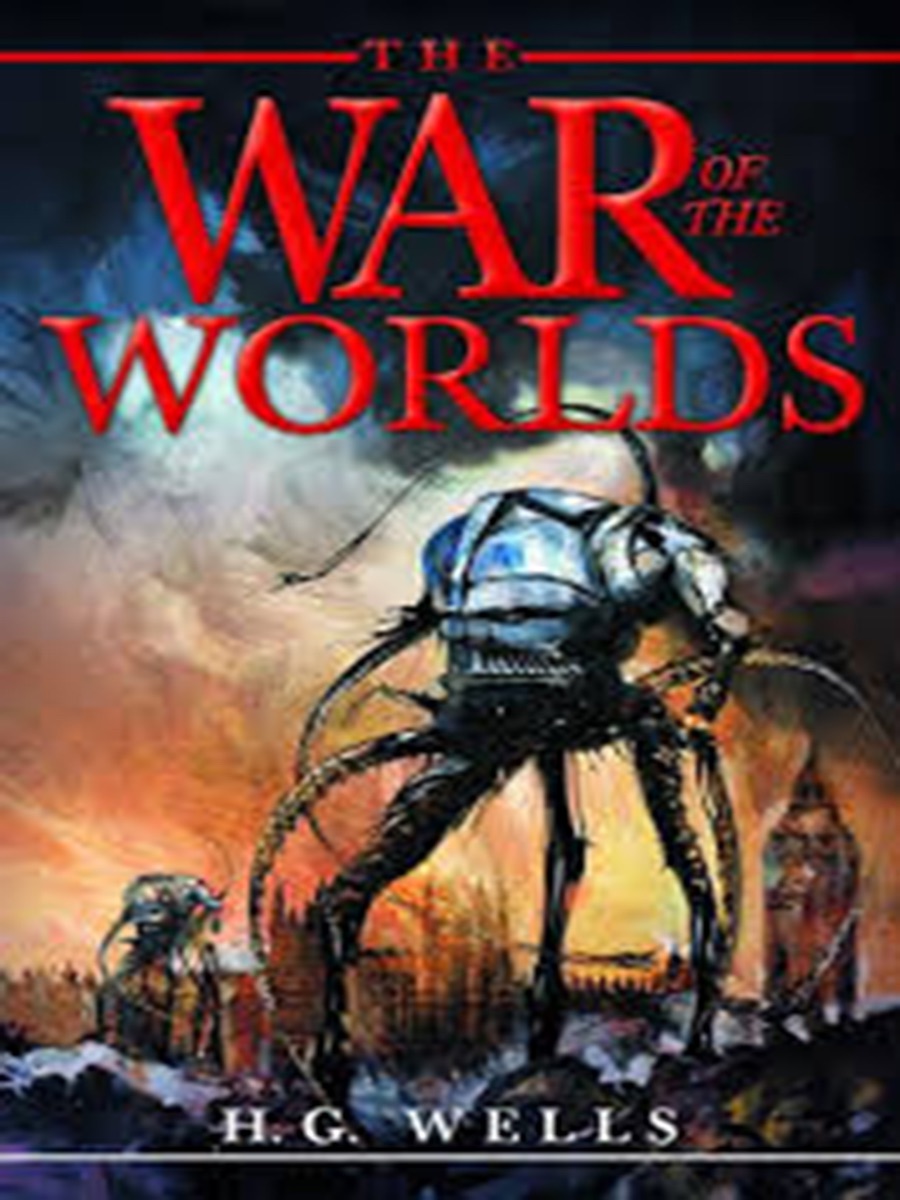
The War of the Worlds
by H. G. Wells
The original alien invasion — H.G. Wells's 1898 masterwork that launched a genre and still delivers real dread.
The story
In late Victorian England, astronomers first notice unusual activity on Mars. Days later, a cylinder crashes onto Horsell Common near London. When the Martians emerge and turn their heat-ray on a crowd of curious onlookers, the narrator — an ordinary man, not a hero — watches civilisation begin to fall. British artillery fails. London empties. The narrator hides, flees, survives by luck, and endures unimaginable pressure. Meanwhile, the rest of the world holds its breath. This is the story of what it feels like when humanity encounters something it cannot defeat.
Age verdict
Best fit for ages 14-17; mature 13-year-olds with strong reading skills can engage fully. The moral complexity, extensive deaths, and PTSD themes are most meaningful with some life experience and historical context.
Our take
Educational classic — scored significantly higher by teachers than by kids, reflecting Wells's canonical status, pedagogical versatility, and moral complexity rather than immediate reading entertainment. The Victorian prose and retrospective narration reward academic engagement over instinctive page-turn pleasure.
What stands out
Each audience's top 3 dimensions. Out of 30 scored per book.
Kids love
- Mental movie Strong
The Sand Warrior — both create vivid visual worlds without illustrations. Sits below because Wells's prose-only imagery (tripods in lightning storm, blood-red weed choking Earth, Dead London's silent streets echoing with 'Ulla, ulla, ulla') rivals painted detail but requires more reader imaginative effort; graphic medium provides instant visual access.
- New world unlocked Strong
Comparable to Earthquake in the Early Morning — both unlock genuine new real-world intellectual territory. Sits at because Wells's founding sci-fi framework (planetary cooling hypothesis, bacterial immunity, industrial-age existential dread) is as territory-opening as Earthquake's historical 1906 earthquake context; both teach readers to see their world transformed.
Parents love
- Writing quality Exceptional
Comparable to Charlotte's Web — both achieve genuinely literary prose rewarding re-reading. Sits below because Wells reaches mastery in isolated passages (opening period sentence, Dead London chapter, bacteria revelation with triple anaphora) while Charlotte maintains consistent prose excellence throughout every chapter; Wells has higher peaks but less overall consistency.
- Vocabulary builder Strong
Comparable to A Tale Dark and Grimm — both introduce sophisticated vocabulary naturally through narrative context. Sits at because Wells's scientific vocabulary (nebular hypothesis, putrefactive bacteria, anaphora, secular cooling) is equally ambitious as Grimm's fairy-tale register; Lexile 1170L matches across both texts.
Teachers love
- Mentor text quality Exceptional
Comparable to City of Bones — both offer multiple distinct craft lessons. Sits below because Wells provides four teachable moments (periodic sentence structure, irony via juxtaposition, sensory atmosphere creation, scientific credibility technique) while City of Bones packs voice + world + mystery + stakes + aesthetic cohesion into single opening chapter; quantity equivalent but pedagogical density per passage differs.
- Cross-curricular value Exceptional
Tier 3: Comparable to A Wolf Called Wander and A Reaper at the Gates — Sits at or above because Wells connects to five distinct learning domains: history (British Empire and Tasmanian genocide), biology (bacterial immunity, Darwinian evolution, planetary cooling), sociology (mass panic and social order collapse), philosophy (human hubris and cosmic humility), and literature (Victorian prose analysis). Exceeds Wolf's biology/geography focus.
✓ Perfect for
- • Fans of science fiction who want to read the text that started the alien invasion genre
- • Advanced readers ready for Victorian prose and genuinely complex moral questions
- • Students exploring colonialism, ethics, and the history of science fiction
- • Readers who enjoy survival narratives with intellectual depth and philosophical weight
Not ideal for
Reluctant readers, those who prefer immediate action-first pacing, or younger teens who haven't encountered Victorian prose — the 1170L Lexile and philosophical opening require significant reading stamina.
⚠ Heads up
At a glance
- Pages
- 192
- Chapters
- 27
- Words
- 61k
- Lexile
- 1170L
- Difficulty
- Advanced
- POV
- First Person
- Illustration
- None
- Published
- 1898
- Publisher
- Mirlo Ediciones
- ISBN
- 9786071437242
Mood & style
You'll know it worked when…
Most readers who get through the first Martian attack — the heat-ray massacre in Chapter 1.5 — will finish the book. The relentless military collapse sequence keeps momentum despite Victorian prose density.
More like this
Same genre, similar age range. Ranked by kid score.
Want more picks like this?
Get 5 hand-picked book reviews for your child's age — one email a month.