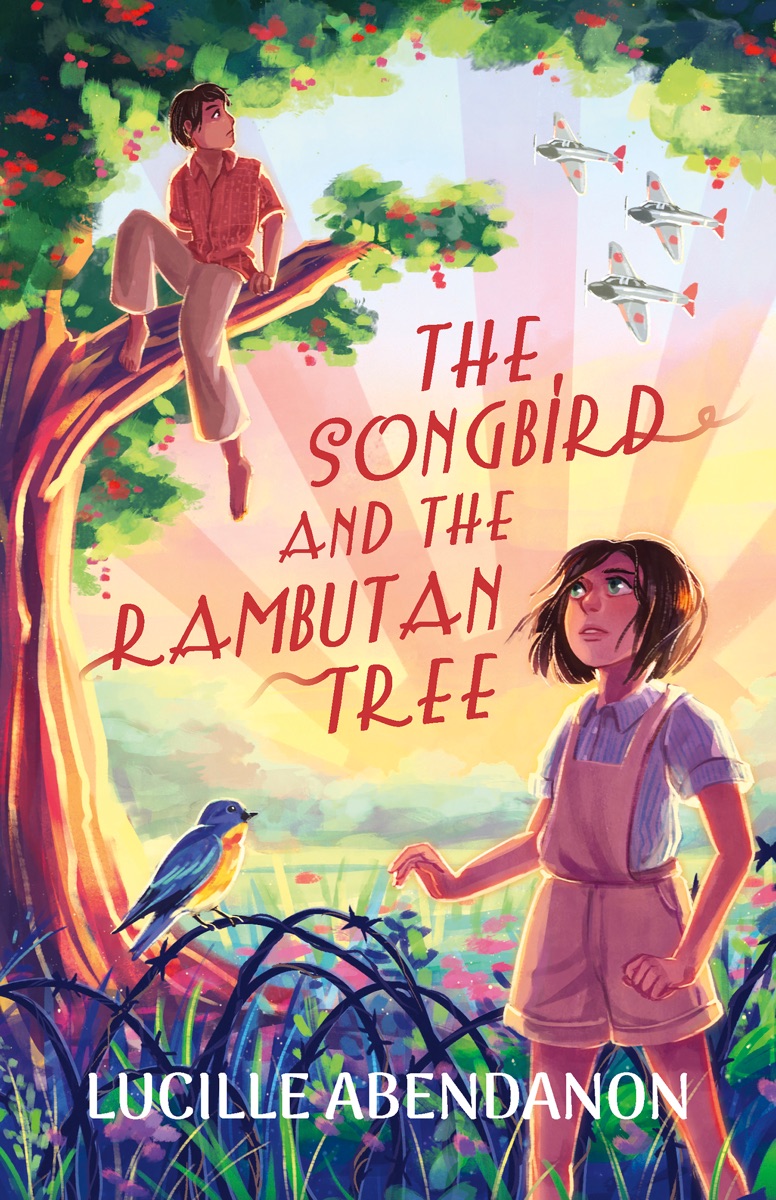
The Songbird and the Rambutan Tree
by Lucille Abendanon
A twelve-year-old girl survives a WWII internment camp in Indonesia, discovering that family is defined by love and loyalty, not blood.
The story
When the Japanese army invades the Dutch East Indies in 1942, twelve-year-old Emmy is separated from her father and confined in a women's internment camp in Batavia. Over three years of hardship, she forms unexpected bonds with a former rival and a grieving mother, while clinging to hope that the people she loves are still alive. Based on the author's grandmother's real experiences in the Tjideng camp.
Age verdict
Best for ages 10-12 with emotional readiness for wartime themes. Mature 9-year-olds can handle it with adult support. The short chapters and accessible voice help younger readers while the depth rewards older ones.
Our take
Literary historical fiction — teacher and parent scorecards lead because of exceptional educational value and emotional sophistication, while kid engagement is strong but tempered by the serious tone and low humor content typical of the genre.
What stands out
Each audience's top 3 dimensions. Out of 30 scored per book.
Kids love
- Middle momentum Strong
Off the Hook — fifty short chapters create continuous forward momentum through nested tensions (daily hunger, weekly mysteries, long-arc separation). Each chapter ends on revelation, emotional beat, or decision. Sits at K2=8 because the middle sustains momentum through escalating information and subplot interweaving without flagging.
- Character voice Strong
Violet's imperious certainty, Bakti's careful formality, Toby's innocent questions, Kitty's dry resilience. Sits at K3=8 because readers can identify speakers by voice alone without dialogue tags; voice variation is substantial and recognizable.
Parents love
- Real-world window Exceptional
Japanese occupation of the Dutch East Indies, the Tjideng internment camp, Dutch colonial society, Indonesian culture, and the human cost of war. Sits at P6=9 because this historical knowledge is delivered entirely through lived experience, not exposition, about a conflict rarely covered in children's literature.
- Parent-child conversation starter Exceptional
Comparable to Blended — a conversation goldmine covering war, colonialism, internment, the meaning of family, sacrifice, privilege, friendship forged under pressure, and what it means to survive. Sits at P10=9 because every chapter opens meaningful discussion that bridges from the book to real-world history and values, generating conversations that continue for days after finishing.
Teachers love
- Cross-curricular value Exceptional
Comparable to A Wolf Called Wander — a natural thematic unit hub connecting to WWII history, Southeast Asian geography, colonialism and postcolonial studies, cultural identity, social studies, and current events about displacement and internment. Sits at T4=9 because a history teacher and ELA teacher can co-plan meaningfully; historical content is integral to the narrative, not background decoration.
- Empathy & self-awareness Exceptional
Comparable to Breakout — transforms how students see wartime experiences by placing them inside a child's perspective in an unfamiliar cultural context. The protagonist's journey from colonial privilege through internment to gratitude develops empathy for displaced people, children in conflict zones, and those whose identity straddles two cultures. Sits at T8=9 because the perspective immersion is deep and transformative.
✓ Perfect for
- • readers who love historical fiction with strong emotional cores
- • kids interested in WWII history beyond the European theater
- • readers who enjoy survival stories driven by friendship and resilience
- • families looking for books that spark meaningful conversations about war and privilege
Not ideal for
Very sensitive readers who may find themes of starvation, disease, and parental separation too emotionally intense, even though violence is implied rather than shown.
⚠ Heads up
At a glance
- Pages
- 307
- Chapters
- 50
- Words
- 81k
- Difficulty
- Moderate
- POV
- First Person
- Illustration
- None
- Published
- 2024
- Publisher
- Jolly Fish Press
- ISBN
- 9781631638213
Mood & style
You'll know it worked when…
Most readers who get past the first three chapters will finish — the survival stakes and short chapters create irresistible forward momentum.
More like this
Same genre, similar age range. Ranked by kid score.

Want more picks like this?
Get 5 hand-picked book reviews for your child's age — one email a month.