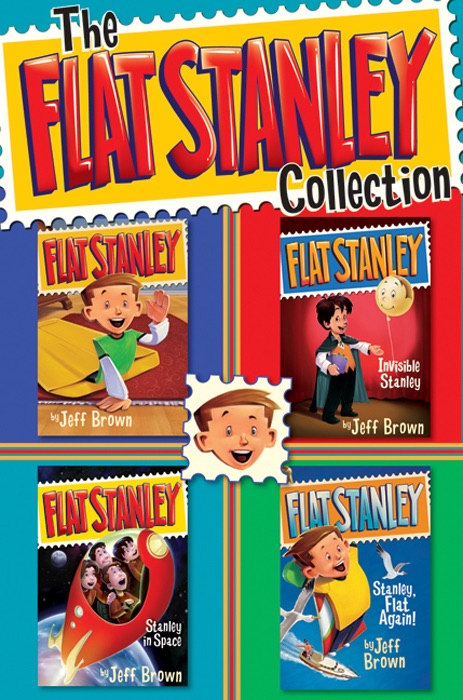
The Flat Stanley Collection
by Jeff Brown · Flat Stanley
The beloved chapter book collection that has launched millions of young readers through gentle humor, absurdist adventures, and a family whose calm never breaks.
The story
When a bulletin board falls on Stanley Lambchop overnight, he wakes up half an inch thick — and discovers that being flat has surprising advantages. Across four books, Stanley and his brother Arthur navigate flatness, invisibility, a space rescue mission, and a second bout of flatness, always with impeccable manners and family teamwork.
Age verdict
Best for grades 1-3 (ages 6-8). Younger kids enjoy it as a read-aloud; kids above grade 3 may find the predictable formula and simple emotions too easy.
Our take
Classroom workhorse with gentle humor: teacher scores lead thanks to the legendary Flat Stanley Project, while kid scores reflect solid-but-modest comedy. Gateway power and project potential are standout strengths.
What stands out
Each audience's top 3 dimensions. Out of 30 scored per book.
Kids love
- First-chapter grab Strong
Comparable to Artemis Fowl , triangulated with All the Broken Pieces — Artemis opens with criminal operation (high psychological stakes), Flat Stanley opens with breakfast → bulletin board falls (emotional family moment). Stanley's hook works because it's instantly visualized and memory-burning ('flat as a pancake'), but the warm family context creates less urgency than crime-thriller opening. Sits at anchor (7) because hook is strong enough for the age group without thriller tension.
- Laugh-out-loud Strong
Comparable to Babymouse and Diary of a Wimpy Kid — all three are reliably funny. Flat Stanley operates on premise humor (being flat is inherently funny), polite understatement (family's calm), and situational comedy (mailing a child). Book 4's guidance counselor scene achieves satirical sophistication. Sits at 7 because humor is consistent and charming rather than maximally varied.
Parents love
- Reading gateway Strong
Comparable to Mercy Watson — both are legendary gateway chapter books. Flat Stanley's short chapters (800-1500 words), large print, illustrations, irresistible premise, and gentle pace make it ideal for readers transitioning from picture books. The Flat Stanley Project—mailing paper Stanleys worldwide and tracking their journeys—is one of the most successful classroom reading engagement programs in American elementary education. Sits at anchor for unquestionable gateway power and real-world cultural impact.
- Creative spark Strong
Comparable to existing data — the premise generates immediate creative play. Kids imagine flatness scenarios, draw paper Stanleys, and write letters for the Project. The Flat Stanley Project channels this into sustained creative output across thousands of classrooms. Sits at 7 for the real but contained creative spark—the project is structured creative output rather than open-ended imagination explosion.
Teachers love
- Project potential Strong
Comparable to books with legendary project integration — the Flat Stanley Project (mailing paper Stanleys worldwide and tracking their journeys) is one of the most successful school exchange programs in American elementary education. Beyond that, the collection supports art (drawing Stanleys and adventure scenes), geography (mapping travel routes), science (space, physics), creative writing (Stanley adventure stories), and comparative analysis (how different books solve the same five-beat problem). Sits at 8 for transformative project power.
- Read-aloud power Strong
Comparable to Lunch Lady , triangulated with Interrupting Chicken — both have distinct performable voices in dialogue. Flat Stanley's voices (Mrs. L's correction rhythm, Mr. L's deadpan, Emma's complaints, guidance counselor's bumbling) are highly distinct in oral performance. Running gags create participation moments. Sits at 7 rather than 8 because prose minimalism limits the sophistication of read-aloud craft compared to fully illustrated books that integrate visual and textual performance.
✓ Perfect for
- • Early readers ready for their first chapter book series
- • Kids who love 'what if?' scenarios and silly premises
- • Classrooms participating in the Flat Stanley Project mail exchange
Not ideal for
Older readers seeking complex plots, emotional depth, or unpredictable stories. The formulaic structure and simple vocabulary are designed for ages 6-8 and may feel too young for confident readers above grade 3.
At a glance
- Pages
- 384
- Chapters
- 19
- Words
- 38k
- Lexile
- 550L
- Difficulty
- Easy
- POV
- Third Person Omniscient
- Illustration
- Moderate
- Published
- 2012
Mood & style
You'll know it worked when…
Most readers in the target age range will finish all four books enthusiastically. The short chapters and episodic structure allow flexible stopping points.
More like this
Same genre, similar age range. Ranked by kid score.

Dog Man: The Scarlet Shedder
by Dav Pilkey
The Bad Guys in Intergalactic Gas
by Aaron Blabey

The Day My Butt Went Psycho
by Andy Griffiths
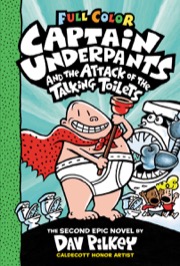
Captain Underpants and the Attack of the Talking Toilets
by Dav Pilkey
Want more picks like this?
Get 5 hand-picked book reviews for your child's age — one email a month.