
Cam Jansen and the Chocolate Fudge Mystery
by David A. Adler · Cam Jansen Mysteries #14
A transitional chapter-book mystery where a girl with photographic memory helps solve a neighborhood crime while fundraising for a local charity.
The story
Cam Jansen and her friend Eric are selling fudge door-to-door to raise money for the Ride and Read program when Cam notices something odd about a woman in a raincoat and dark glasses near a seemingly empty house. As the pair investigate across eight short chapters — checking garbage, reading newspapers, and staking out the neighborhood — evidence accumulates that something more serious than curiosity is at stake. The book balances a logical mystery puzzle with an authentic suburban community backdrop and a warm friendship between the lead duo.
Age verdict
Best fit: grades 2-3 (ages 7-9). Still works for confident grade 1 readers or reluctant readers through grade 5.
Our take
kid-friendly transitional mystery that engages early readers with a puzzle hook and mild humor; parent growth-value is moderate because emotional depth and writing quality stay deliberately light for the format, while teachers get solid critical-thinking and reluctant-reader utility
What stands out
Each audience's top 3 dimensions. Out of 30 scored per book.
Kids love
- First-chapter grab Strong
The opening establishes Cam's 'Click' photographic memory within the first minutes alongside a mysterious woman in dark glasses and raincoat depositing a black bag — a double-hook that sets premise and puzzle inside 15 sentences. Stronger than Nate the Great openings (6, cozy but slow) but less visceral than Stone Fox (9, immediate emotional stakes); closest match is Junie B. Jones (7, voice-plus-situation double-hook for early readers).
- Middle momentum Strong
Chapters 2-7 layer evidence one beat per chapter — garbage contents, stacked newspapers, mail patterns, the man's emergence, the Crime Watch article — so early readers never hit a dead chapter. Similar steady-evidence pull to Encyclopedia Brown (7, one puzzle per chapter) and stronger than Nate the Great middle stretches (6). Falls short of thriller-level pull like Holes (9) because stakes stay investigative, not existential.
Parents love
- Real-world window Strong
The whole book is a suburban-community tour — mail-delivery patterns, garbage collection, newspaper Crime Watch columns, how police respond to tips, how charity fundraisers work for elderly neighbors. In Ch.6 the kids navigate a real newspaper archive to verify the bank robbery. Stronger than Junie B. Jones (5, narrow school world) and comparable to Ramona (7, neighborhood texture). Genre DNA (mystery/realistic) rewards this — Cam's world is recognizably the reader's.
- Reading gateway Strong
Exactly the transitional-chapter-book design — short chapters, dialogue-heavy, accessible Lexile 620L, 64 pages, book-fair and Scholastic distribution. The 'Click' mechanism gives reluctant readers an immediate hook before committing to chapter-length prose. Strong gateway power matches Junie B. Jones (7, first-chapter-book bridge) and Magic Tree House (8, ubiquitous on-ramp). Floor=6 from book-fair presence; capped at 7 by evidence quality.
Teachers love
- Critical thinking development Strong
The whole book is a working model of hypothesis → evidence → revision — Eric's Ch.2 nightgown theory is literally 'consider alternative explanations before accepting the first one,' and Ch.3-6 walk readers through refining a theory with new data. Stronger than Encyclopedia Brown (6, solution-reveal format) and matches Chasing Vermeer (7, reader-solves-alongside). Below From the Mixed-Up Files (8, richer deduction) but genuine thinking-skill practice.
- Reluctant reader rescue Strong
Textbook reluctant-reader design — 8 short chapters, Lexile 620L, dialogue-driven scenes, immediate mystery hook with the raincoat woman in Ch.1, and the easy-entry 'Click' device. Book-fair presence and series momentum help re-engagement. Comparable to Magic Tree House (8, classic reluctant-reader rescue) and Junie B. Jones (7). Gate floor=6; capped at 7 by evidence quality.
✓ Perfect for
- • newly independent readers ready for their first chapter-book mysteries
- • kids who like solving puzzles alongside the protagonist
- • reluctant readers who need short chapters and a strong hook
- • fans of Nate the Great or Encyclopedia Brown looking for a slightly longer read
Not ideal for
readers seeking deep emotional stakes, literary prose, or unpredictable plot twists — this book trades complexity for accessibility
At a glance
- Pages
- 64
- Chapters
- 8
- Words
- 9k
- Lexile
- 620L
- Difficulty
- Easy
- POV
- Third Person Limited
- Illustration
- Sparse
- Published
- 1993
- Publisher
- Viking Juvenile / Puffin
- Illustrator
- Susanna Natti
Mood & style
You'll know it worked when…
Most kids finish in 1-2 sittings; the accessible format and constant forward motion make abandonment rare.
More like this
Same genre, similar age range. Ranked by kid score.

The Name of This Book Is Secret
by Pseudonymous Bosch
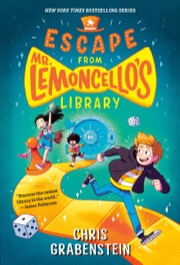
Escape from Mr. Lemoncello's Library
by Chris Grabenstein

The Haunted Serpent
by Dora M. Mitchell

If You're Reading This, It's Too Late
by Pseudonymous Bosch
Want more picks like this?
Get 5 hand-picked book reviews for your child's age — one email a month.