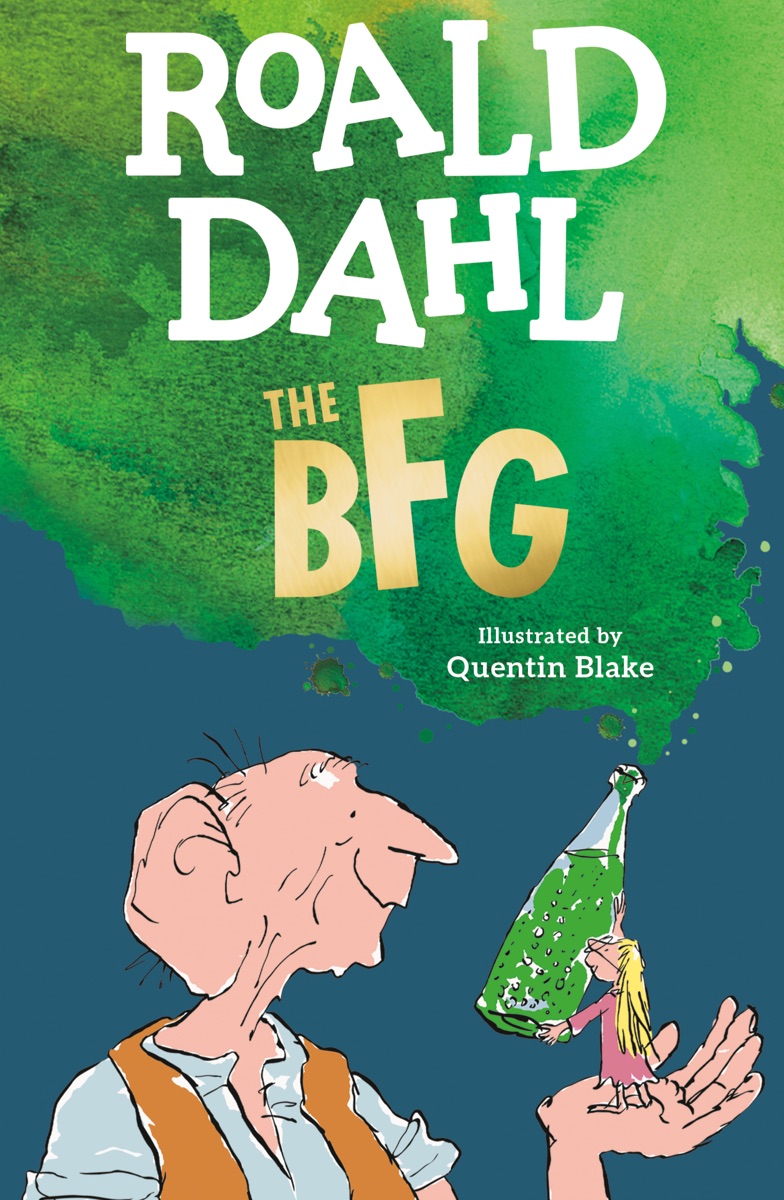
The BFG
by Roald Dahl
A masterclass in whimsical wordplay and unlikely friendship that turns a kidnapped orphan and a dream-catching giant into one of children's literature's most beloved duos
The story
When orphan Sophie is snatched from her dormitory by a 24-foot giant, she expects to be eaten. Instead, she discovers the Big Friendly Giant — the only giant who refuses to eat 'human beans.' Together they must convince the Queen of England to help stop nine man-eating giants who hunt children every night. Armed with bottled dreams and the BFG's extraordinary ears, Sophie devises a plan so audacious it requires a queen's army, nine helicopters, and one very brave little girl.
Age verdict
Best at 8-10 when the gobblefunk delights and the moral stakes land without overwhelming. Works from 6 (with a reader) through 12 (for the craft appreciation).
Our take
A voice-and-humor powerhouse that teachers treasure for read-aloud magic and craft instruction. The BFG's iconic speech and Dahl's comedic architecture drive the strongest scores, while the fantasy setting naturally limits real-world grounding. A beloved classroom classic whose distinctive character voice and creative spark outweigh its straightforward plot and moderate emotional depth.
What stands out
Each audience's top 3 dimensions. Out of 30 scored per book.
Kids love
- Character voice Exceptional
Comparable to City Spies , triangulated with Children of Blood and Bone — The BFG's gobblefunk ('I is,' 'human beans,' 'scrumdiddlyumptious') is instantly recognizable and performable. Sophie's directness ('Why Turks? What's wrong with the English?') creates sharp contrast. The Bloodbottler's cruel variant deepens distinctiveness. Swap test works perfectly—readers identify characters without tags. Sits at K3=9 tier: voice distinctiveness matches City Spies' five kids with recognizable speech patterns. The BFG's playground performability is exceptional, though lacking the visceral YA-level prose contrast of COAB .
- Laugh-out-loud Exceptional
linguistic wordplay (Wales/whales, Wellington/boots), absurdist logic (frobscottle's downward bubbles creating 'whizzpoppers'), situational comedy (BFG on grand piano, chandelier disaster), and the taste-preference sequence as a comedy masterclass. Humor shifts strategically—minimal in chapters 1-3 and 17-29, humor-heavy in chapters 5-10—serving as emotional recovery mechanism. Sits at K4=9 tier because multiple humor channels fire throughout, matching Pigeon's escalating absurdity, though not Dog Man's five-channel relentless pace .
Parents love
- Writing quality Strong
'The moonbeam was like a silver blade slicing through the room on to her face'—precise imagery, varied sentence rhythm that mirrors emotional states, and dialogue that reveals character through distinctive speech patterns rather than attribution. Economical sensory writing trusts readers and illustrator alike. Sits at P2=8 tier: masterful sentence-level control matches Interrupting Chicken's precision. BFG's prose is excellent but not format-innovative like Illuminae's experimental text-message narrative .
- Reading gateway Strong
Babymouse Goes for the Gold — Accessible prose paired with the BFG's irresistible voice, manageable chapter lengths, 79 illustrations providing visual breaks, humor that rewards page-turning, and a clear forward-moving plot lower barriers effectively. A child who resists 'chapter books' can be lured in by the whizzpopper scene and stay for the adventure. Sits at P7=8 tier: multi-channel accessibility matches this anchor well, removing barriers without graphic-format safety of higher tiers (P7=9-10).
Teachers love
- Read-aloud power Exceptional
the BFG's gobblefunk demands vocal characterization, Sophie's clipped directness provides rhythmic contrast, and comedy set pieces (taste-preference conversation, Palace breakfast whizzpopper) create classroom eruptions. Natural pacing matches read-aloud sessions perfectly. Sits at T1=9 tier: performable voice and rhythm match this anchor. BFG IS built for performance, but not explicitly designed as Interrupting Chicken's picture-book two-voice structure . Classroom reality: whizzpopper scenes produce genuine eruptions.
- Classroom versatility Strong
read-aloud (performable voices), novel study (thematic depth), literature circles (debatable moral questions), mentor text (voice, humor, sensory writing), independent reading (accessible length), and creative writing prompts. Over 100 existing lesson plans on Teachers Pay Teachers confirm institutional adoption. Sits at T2=8 tier: strong versatility across multiple classroom modes matches this anchor without the four-grade-span reach of higher tiers (T2=9-10).
✓ Perfect for
- • kids who love creative wordplay and invented language
- • families looking for read-aloud magic with performable voices
- • readers who enjoy unlikely friendships between small heroes and gentle giants
- • teachers seeking mentor text material for voice, humor, and creative writing
Not ideal for
Children deeply unsettled by the concept of monsters that eat children (even presented abstractly), or readers who need fast-paced action throughout with no discovery-paced middle sections
⚠ Heads up
At a glance
- Pages
- 224
- Chapters
- 29
- Words
- 45k
- Lexile
- 720L
- Difficulty
- Moderate
- POV
- Third Person Limited
- Illustration
- Heavy
- Published
- 1982
- Publisher
- Puffin Books
- Illustrator
- Quentin Blake
- ISBN
- 9780142410387
Mood & style
You'll know it worked when…
Most kids finish in 3-5 sittings; the BFG's voice and humor pull them through even the slower discovery chapters
More like this
Same genre, similar age range. Ranked by kid score.
Harry Potter and the Philosopher's Stone
by J.K. Rowling
Bone #4: The Dragonslayer
by Jeff Smith
Wings of Fire: The Hidden Kingdom
by Tui T. Sutherland

The Neverending Story
by Michael Ende
Want more picks like this?
Get 5 hand-picked book reviews for your child's age — one email a month.