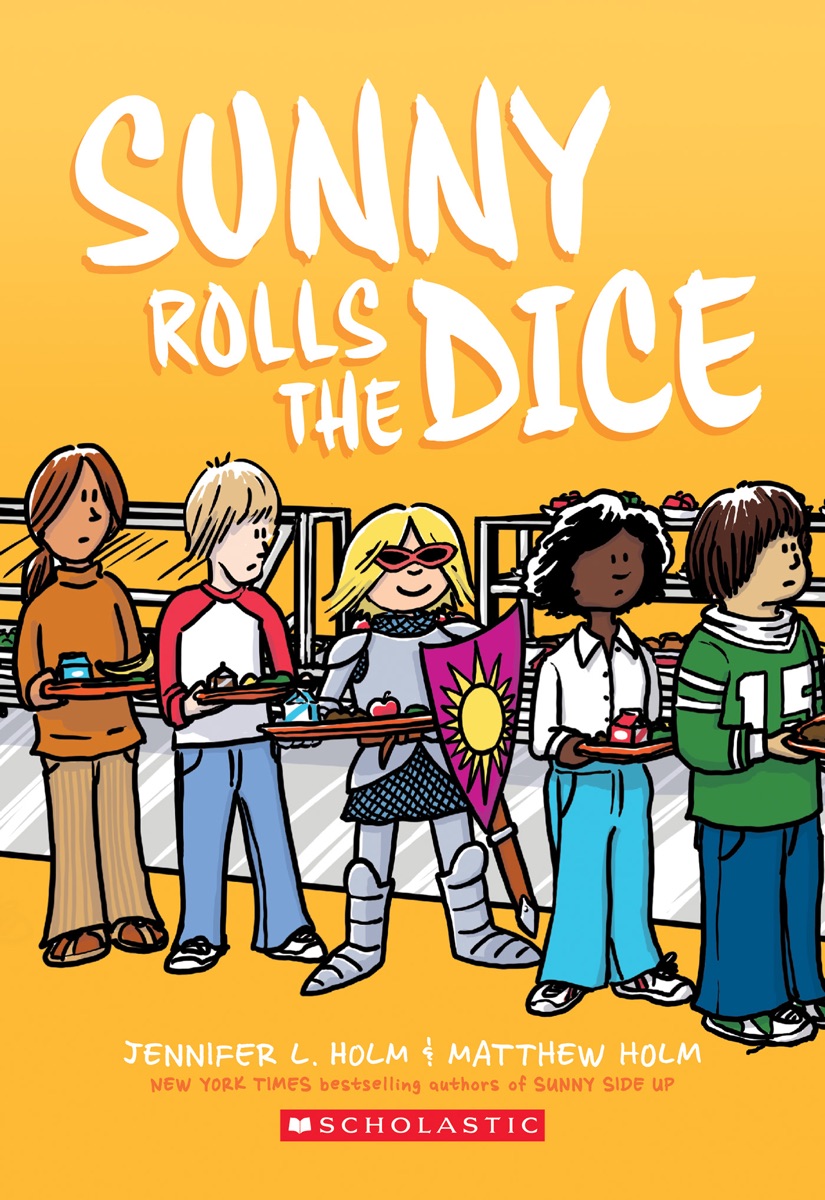
Sunny Rolls the Dice
by Jennifer L. Holm · Sunny #3
A warm graphic novel about finding your people when the cool kids aren't your people
The story
Sunny Lewin is navigating the confusing world of middle school in the 1970s, where fitting in seems to require the right clothes, the right friends, and the right interests. When she stumbles into a tabletop gaming group, she discovers something unexpected about what it means to be yourself — and what real friendship looks like.
Age verdict
Best for ages 9-11. Social anxiety and identity themes hit hardest during the middle-school transition. Safe and rewarding for sensitive readers — the emotional content is real but never overwhelming.
Our take
Well-balanced graphic novel that scores consistently across kid and parent perspectives, with a modest dip in teacher utility due to format limitations on read-aloud and traditional text analysis. Strongest in stereotype-breaking representation, creative inspiration, and world-expansion through gaming culture.
What stands out
Each audience's top 3 dimensions. Out of 30 scored per book.
Kids love
- New world unlocked Strong
For readers unfamiliar with tabletop role-playing games, this book opens an entirely new domain — complete with its own vocabulary, social customs, creative possibilities, and community. Many kids will finish this wanting to try Dungeons and Dragons themselves, and the 1970s setting adds a second layer of discovery about how kids lived before the digital era. The world-expansion extends well beyond the final page.
- First-chapter grab Strong
The opening pop quiz scene drops readers directly into Sunny's anxious internal monologue, making the social stakes feel immediate and relatable. The graphic novel format lets kids see her panic through expressive facial close-ups before a single word of backstory, creating a stronger emotional hook than most text-only openings achieve for this age group.
Parents love
- Stereotype-breaker Strong
Sunny shatters the stereotype that girls don't belong in gaming culture, while her friend group includes South Asian, Orthodox Jewish, and brown-skinned characters who are portrayed as fully realized individuals rather than diversity markers. The book quietly dismantles middle-school social hierarchy by showing that the popular-kid standard is arbitrary and that kids who opt out of the status game aren't losers — they are simply playing a different, more rewarding game.
- Creative spark Strong
The book is essentially a gateway drug for tabletop gaming creativity — readers will want to create their own characters, design campaigns, and roll dice. Beyond the gaming connection, the basement's transformation from storage space to imagined dungeon invites kids to reimagine their own ordinary spaces as portals to adventure. The creative output potential is immediate, tangible, and sustained well beyond the final page.
Teachers love
- Discussion fuel Strong
Questions about peer pressure, authenticity versus conformity, and what constitutes real friendship generate genuine student engagement and disagreement. Students can meaningfully debate whether Sunny should have tried harder with the popular crowd, whether gaming culture is unfairly stigmatized, and what they would do in her situation. The diversity of the friend group also opens discussions about representation and inclusion.
- Empathy & self-awareness Strong
Students who feel like social outsiders will see themselves validated in Sunny's experience, while students who have never felt excluded gain genuine insight into what that experience feels like from inside. The portrayal of popular kids as neither villains nor heroes — just kids making different choices — models nuanced empathy that avoids simple hero-villain framing of social dynamics.
✓ Perfect for
- • Kids who feel like social outsiders
- • Graphic novel readers ages 9-12
- • Fans of Raina Telgemeier or Svetlana Chmakova
- • Kids curious about tabletop gaming
- • Readers who enjoy stories about finding unexpected friendships
Not ideal for
Readers seeking action-heavy adventure, pure comedy, or fantasy world-building. The story's strengths are emotional and social rather than plot-driven, and the stakes are interpersonal rather than physical.
At a glance
- Pages
- 224
- Chapters
- 20
- Words
- 6k
- Lexile
- 470L
- Difficulty
- Easy
- POV
- First Person
- Illustration
- Fully Illustrated
- Published
- 2019
- Publisher
- Graphix
- Illustrator
- Matthew Holm
- ISBN
- 9781338233148
Mood & style
You'll know it worked when…
Most kids will finish in one or two sittings. The visual format and short chapters make it feel fast.
More like this
Same genre, similar age range. Ranked by kid score.

Want more picks like this?
Get 5 hand-picked book reviews for your child's age — one email a month.