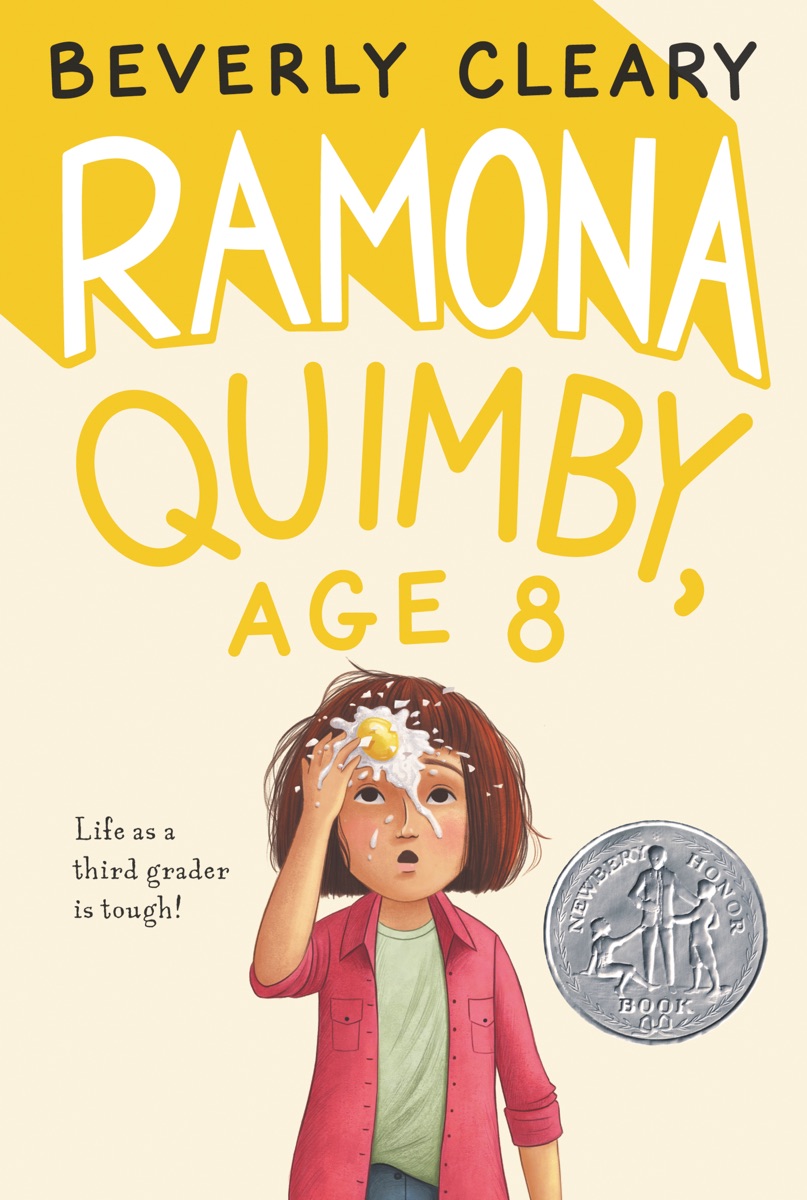
Ramona Quimby, Age 8
by Beverly Cleary · Ramona Quimby #6
A warm, honest portrait of an eight-year-old navigating school anxiety, family stress, and the fear of being misunderstood — Beverly Cleary's Newbery Honor classic.
The story
Ramona starts third grade at a new school, rides the bus alone, and stays with a neighbor after school while her parents work and study. Between classroom embarrassments, cooking experiments gone wrong, and the lingering worry that her teacher doesn't actually like her, Ramona discovers that being eight means dealing with real feelings about real problems — and that imperfect families can still be wonderful ones.
Age verdict
Best for ages 7-9 (Ramona's peers), but works beautifully as a read-aloud for 6-year-olds and remains enjoyable for older readers through nostalgia and emotional resonance.
Our take
Consistent literary craftsperson — scores uniformly strong across all three audiences without dramatic peaks or valleys, reflecting Beverly Cleary's hallmark of sustained, quiet excellence. Slightly favored by teachers for exceptional read-aloud quality and classroom versatility.
What stands out
Each audience's top 3 dimensions. Out of 30 scored per book.
Kids love
- Character voice Strong
Comparable to Children of Blood and Bone , triangulated with The Golem's Eye — Ramona's voice is one of the most distinctive in children's literature with concrete observations, age-authentic worries, self-invented nicknames. Supporting cast (Danny/Yard Ape, Willa Jean, Mrs. Whaley) each speak distinctly. Sits below anchor 10 because while exceptional, the voice is bounded by realistic third-grade vocabulary rather than cross-genre linguistic range.
- Ending satisfaction Strong
Something Wonky This Way Comes — final chapter resolves central emotional question (family acceptance despite imperfections) with warmth and honesty. Closing line about 'beginning again tomorrow' is conclusive yet real, not fairy-tale neat. Sits at comparable level because every thread resolves emotionally rather than requiring reader synthesis.
Parents love
- Writing quality Strong
Comparable to Interrupting Chicken — Cleary's prose demonstrates masterful restraint with clean sentences varying in rhythm, dialogue revealing character without attribution gymnastics, emotional moments rendered through physical action rather than explanation. Newbery Honor recognition reflects genuine literary craft. Sits at 8 (not 9-10) because mastery is quiet rather than innovative or genre-pioneering.
- Stereotype-breaker Strong
messy, impulsive, angry, occasionally unkind, never shamed. Stands ground on bodily autonomy (refusing food), uses intelligence for difficult social situations, confronts authority when she feels misjudged. Sits at 7 (not higher) because the stereotype break is thematic rather than systemic across the narrative.
Teachers love
- Read-aloud power Exceptional
Comparable to Artemis Fowl , sits at 9 — Cleary's prose ranks among finest for classroom read-aloud. Every character has performable voice, emotional beats land powerfully in group settings, chapter lengths fit class periods precisely. Scenes invite vocal performance and sound effects. Students lean forward during vulnerability and laugh during absurdity with equal investment. Sits at 9 (not 10) because performance quality is exceptional rather than genre-defining.
- Classroom versatility Strong
Comparable to Earthquake in the Early Morning , triangulated with A Tale Dark and Grimm — works effectively across read-aloud with discussion, novel study with comprehension, literature circles, mentor text analysis, independent reading for developing readers, creative writing prompts. Teacher can build multi-week unit with varied strategies. Sits at 7 because versatility is proven rather than exceptionally innovative in pedagogical design.
✓ Perfect for
- • Children navigating new-school anxiety or after-school care situations
- • Readers who enjoy realistic stories about everyday family life
- • Kids who like protagonists who are messy, honest, and imperfect rather than heroic
- • Families looking for a read-aloud with natural discussion moments
Not ideal for
Readers seeking fantasy, adventure, or high-stakes plot-driven stories will find this too grounded in everyday life. Children who prefer fast-paced visual storytelling may find the prose-focused format slower than graphic novels or illustrated diary formats.
⚠ Heads up
At a glance
- Pages
- 190
- Chapters
- 9
- Words
- 25k
- Lexile
- 860L
- Difficulty
- Moderate
- POV
- Third Person Limited
- Illustration
- Sparse
- Published
- 1981
- Publisher
- Oxford University Press, USA
- Illustrator
- Tracy Dockray
- ISBN
- 9780192751065
Mood & style
You'll know it worked when…
A capable third grader finishes this in 3-5 sittings. As a nightly read-aloud, expect 9 sessions (one chapter per night) of approximately 15-20 minutes each.
More like this
Same genre, similar age range. Ranked by kid score.
Millionaires for the Month
by Stacy McAnulty
Insignificant Events in the Life of a Cactus
by Dusti Bowling

The Season of Styx Malone
by Kekla Magoon

EllRay Jakes Is Not a Chicken
by Sally Warner
Want more picks like this?
Get 5 hand-picked book reviews for your child's age — one email a month.