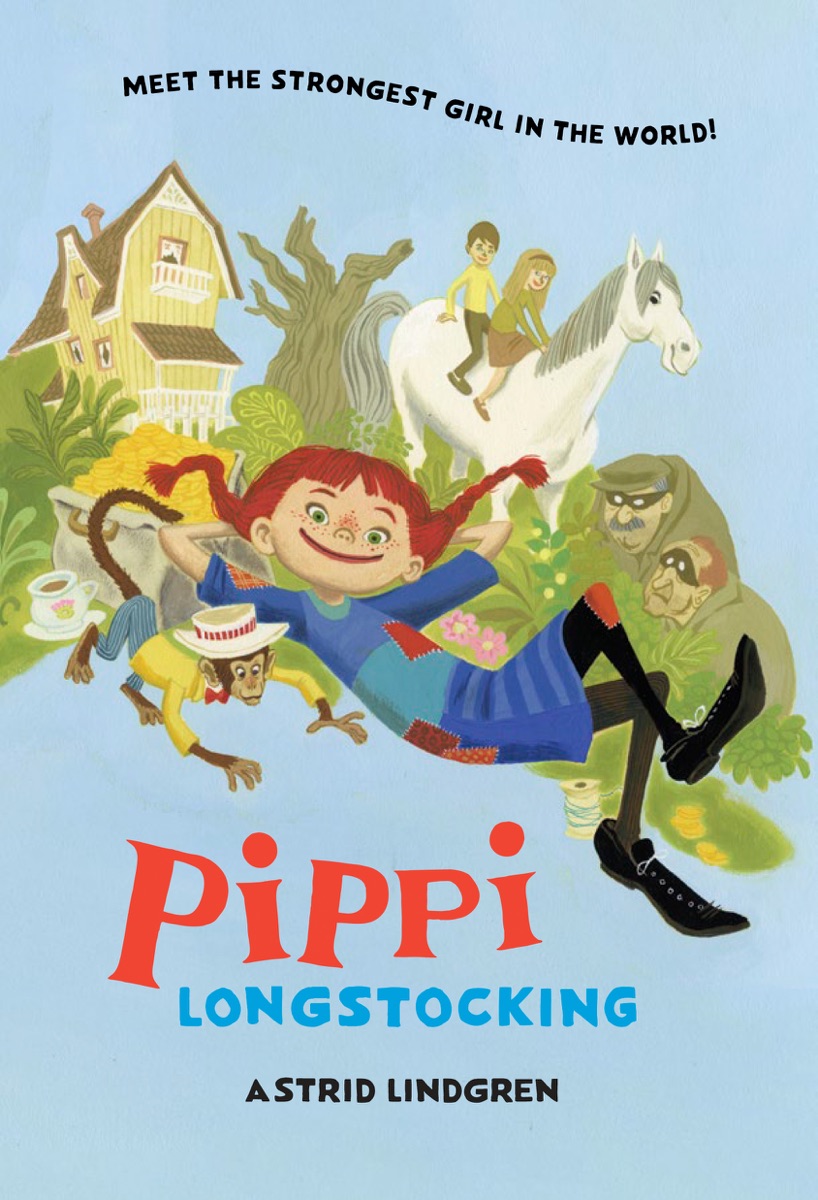
Pippi Longstocking
by Astrid Lindgren · Pippi Longstocking #1
The original rule-breaking girl hero who lives alone, lifts horses, and proves that kindness and strength need no permission
The story
Nine-year-old Pippi Longstocking moves into a rickety old house with a horse, a monkey, and a suitcase full of gold coins — and no parents to tell her what to do. Through a series of adventures with her neighbors Tommy and Annika, she outwits authority figures, defeats bullies, disrupts social gatherings, and ultimately proves that her unconventional strength serves genuine good. Written in 1945, this Swedish classic remains one of children's literature's most joyful celebrations of independence and authenticity.
Age verdict
Best for ages 7-10. Strong readers as young as 6 can enjoy it read aloud, and the thematic depth rewards readers up to 12. The sweet spot is 8-9, when the fantasy of living independently feels most magical.
Our take
A classic that teachers value most for its rich classroom applications, while kids enjoy its humor and iconic protagonist, and parents appreciate its radical stereotype-breaking. The slight teacher advantage reflects the book's exceptional versatility as a teaching text.
What stands out
Each audience's top 3 dimensions. Out of 30 scored per book.
Kids love
- Character voice Exceptional
Comparable to City Spies — Pippi's voice is immediately distinctive through word invention (pluttifikation, surkus, fridolize) and deadpan tall tales. Five distinct characters resonate; Pippi's voice carries three distinct friend voices (Tommy cautious, Annika worried). Sits above because Pippi's voice is the book's signature rather than one of five. Tier 3 escalation: high-stakes anchor, shift +1, uniqueness of voice centrality.
- First-chapter grab Strong
Comparable to Lunch Lady and the Cyborg Substitute — Both open in grounded, kid-relatable spaces (cafeteria vs. villa) with immediate rule-breaking energy. Pippi's carrot hair, potato nose, and first act of lifting a horse all land within opening pages. Sits at anchor because immediate hook is equally vivid and unexpected.
Parents love
- Stereotype-breaker Exceptional
physically strongest in every scene, lives independently without supervision, rejects authority on own terms. Orphanhood is empowering not pitiable. Inverts orphan/gender/child-adult power dynamics simultaneously—archetype that inspired generations. Sits at anchor.
- Re-read durability Strong
Comparable to Charlotte's Web — Episodic structure invites return to favorite chapters without full rereads. Second reading gains layers (coffee party poignancy reveals Pippi's genuine effort to conform). Dual-audience operation means adults discover new meaning. Strong re-read durability.
Teachers love
- Read-aloud power Strong
opening sentence repetitive construction; Pippi's dialogue inherently performable with distinct voice; nonsense phrases ("Tiddelipom and piddeliday") fun to say. Fire rescue holds group attention through escalation. Chapter lengths fit class periods. Sits at anchor.
- Classroom versatility Strong
Hard Luck — Works across read-aloud, independent reading, novel study, literature circles, mentor text analysis. Episodic structure allows individual chapters as standalone texts. Rich discussion across ethics, social studies, writing craft. Adaptable to multiple curriculum goals. Sits at anchor.
✓ Perfect for
- • Kids who love strong, funny, unconventional heroines
- • Readers ready to move from picture books to chapter books
- • Children who enjoy episodic adventures they can read one chapter at a time
- • Families looking for a classic that sparks real conversations about rules and independence
Not ideal for
Readers who prefer plot-driven stories with sustained mystery or rising tension may find the episodic structure repetitive. Some cultural references reflect 1940s attitudes that may need context.
At a glance
- Pages
- 160
- Chapters
- 11
- Words
- 44k
- Lexile
- 870L
- Difficulty
- Moderate
- POV
- Third Person Omniscient
- Illustration
- Sparse
- Published
- 1945
- Publisher
- Oetinger [Hamburg]
- Illustrator
- Louis S. Glanzman
- ISBN
- 9783789141614
Mood & style
You'll know it worked when…
The birthday party chapter provides satisfying emotional closure while the final pirate question opens possibility for imagination.
More like this
Same genre, similar age range. Ranked by kid score.


Want more picks like this?
Get 5 hand-picked book reviews for your child's age — one email a month.