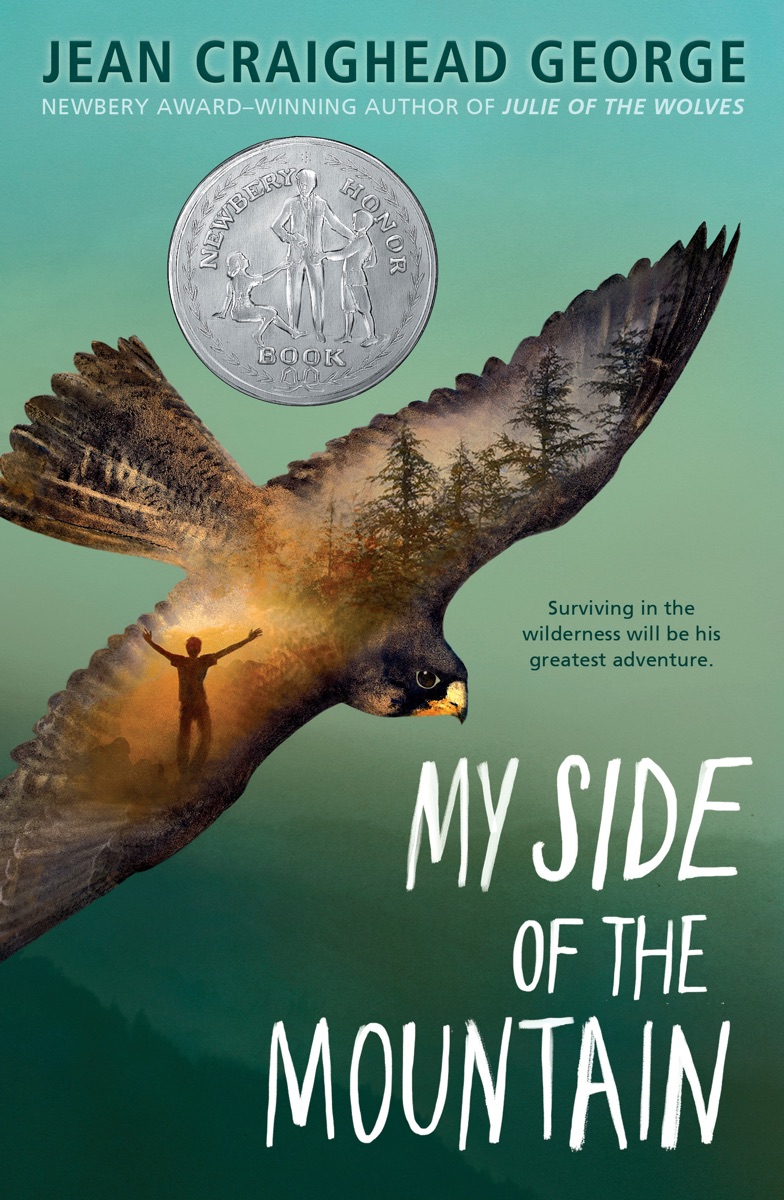
My Side of the Mountain
by Jean Craighead George · Mountain #1
A quiet, vivid survival adventure that teaches real wilderness skills while exploring what independence truly means.
The story
When Sam Gribley runs away from his crowded New York City apartment to live on his great-grandfather's land in the Catskill Mountains, he must learn to survive alone — making fire, finding food, building shelter, and training a wild falcon named Frightful. As the seasons pass, Sam becomes remarkably self-sufficient, while encounters with unexpected visitors raise quiet questions about what it means to live truly independently.
Age verdict
Best for ages 9-12. Younger readers (8+) can handle the content but may find the reflective pace slow. Older readers up to 14 will appreciate the emotional subtlety.
Our take
A teacher-favored classic: rich in cross-curricular content and classroom versatility, valued by parents for real-world knowledge and vocabulary, but less exciting for kids than action-driven or humor-heavy contemporaries. The book's quiet emotional arc and limited humor place it below peak kid engagement while its educational depth makes it a curriculum cornerstone.
What stands out
Each audience's top 3 dimensions. Out of 30 scored per book.
Kids love
- Mental movie Strong
Comparable to Lunch Lady and Cyborg (8) — Hemlock tree, Catskill ridges, snow-covered mountain with smoke from hidden chimney create vivid mental images readers can draw from memory. Sits match.
- New world unlocked Strong
Comparable to Golem's Eye (9) — Opens natural world doors (falconry, plants, fire, ecology) that stay open - kids pursue outdoor projects and nature journaling. Sits match.
Parents love
- Real-world window Exceptional
edible plants by name, fire-making techniques, falconry training details, Catskill ecology with scientific precision. Sits match.
- Writing quality Strong
Comparable to Bake Sale & A Tale Dark and Grimm (triangulation) — Prose has genuine musicality ("Never, never have I seen such trees") with lean, precise sensory detail. Parent recognizes craft in opening. Slightly below Tale Dark and Grimm's narrative-voice mastery. Sits match.
Teachers love
- Cross-curricular value Exceptional
Comparable to survival-focused classics & A Wolf Called Wander (tier 9-10) — Botany (plant ID, seasonal cycles), zoology (falcon behavior, weasel ecology), geography (Catskill mapping), physics (fire-making), history (post-WWII America) all embedded naturally in narrative. Co-planning anchor for cross-curricular units. Sits match at 9.
- Classroom versatility Strong
Comparable to Hatchet-pattern survival (8) — Works for read-aloud, independent reading, literature circles, science integration, novel study - episodic structure enables flexible scheduling. Sits match.
✓ Perfect for
- • Kids fascinated by survival and wilderness skills
- • Nature lovers who want accurate outdoor information in a story
- • Readers who enjoyed Hatchet and want more wilderness adventure
- • Boys (and girls) who prefer action and practical content over social drama
Not ideal for
Readers who need fast pacing, frequent humor, or strong social dynamics — the book is a solitary, reflective adventure with minimal dialogue and a quiet emotional arc.
At a glance
- Pages
- 177
- Chapters
- 15
- Words
- 39k
- Lexile
- 810L
- Difficulty
- Moderate
- POV
- First Person
- Illustration
- Sparse
- Published
- 1959
- Illustrator
- Jean Craighead George
Mood & style
You'll know it worked when…
A child who describes Sam's tree home or asks about edible plants is engaged. A child who says 'nothing happens' may need a faster-paced alternative.
More like this
Same genre, similar age range. Ranked by kid score.
The Last Kids on Earth and the Midnight Blade
by Max Brallier

The Last Kids on Earth and the Cosmic Beyond
by Max Brallier
InvestiGators: Off the Hook
by John Patrick Green

Peak
by Roland Smith
Want more picks like this?
Get 5 hand-picked book reviews for your child's age — one email a month.