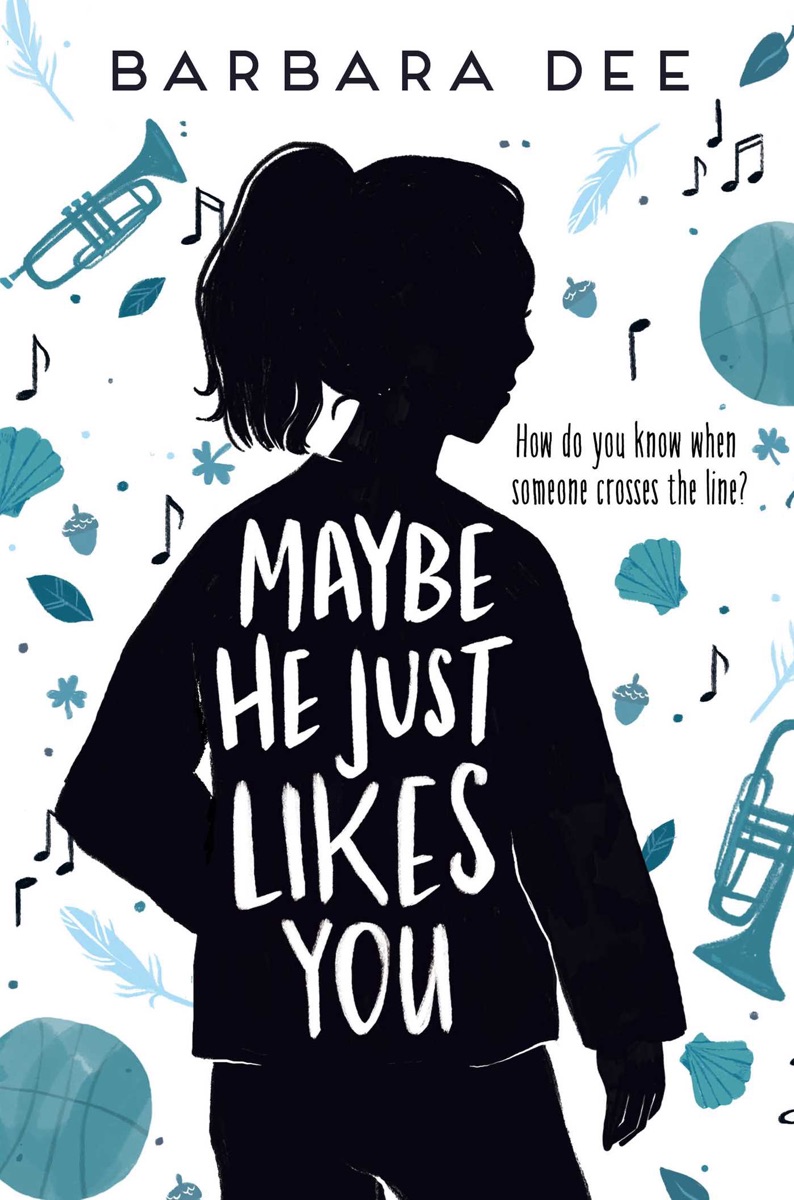
Maybe He Just Likes You
by Barbara Dee
A brave, honest story about a girl learning to trust her instincts when everyone says she's overreacting
The story
When seventh-grader Mila starts getting unwanted attention from boys at school, everyone tells her they're just being friendly. But the hugs last too long, the comments feel wrong, and nobody seems to notice. Through a chance discovery of karate, Mila begins to find her voice, her strength, and the courage to make herself heard.
Age verdict
Best for ages 10-13. The themes of consent and boundaries are most meaningful for kids entering or experiencing middle school, though the accessible reading level works for mature 9-year-olds.
Our take
Teachers and parents champion this craft-rich novel about boundaries far more than kids, who find it meaningful but not thrilling
What stands out
Each audience's top 3 dimensions. Out of 30 scored per book.
Kids love
- Character voice Strong
Mila's metaphor-rich internal voice (moths, blue sky, pebbles, tight throat) paired with five supporting characters' speech patterns (Leo's conditional charm, Zara's emphatic tone, Max's parenthetical facts, Callum's trajectory). City Spies features five equal protagonists; Maybe concentrates voice mastery in narrator with supporting ensemble. Sits below City Spies because breadth is different, though narrator voice depth may exceed any single City Spies character.
- Heart-punch Strong
Ch. 13 (hot flush at violation), Ch. 72 (dry throat telling mother), Ch. 75 (damp hands being heard). Earthquake: three engineered emotional peaks with equivalent sensory delivery. Both trust readers to recognize feeling through body before narration. Sits at anchor level due to equivalent emotional architecture and trust-the-reader approach.
Parents love
- Emotional sophistication Exceptional
teaches gaslighting-through-normalcy (each incident individually deniable, accumulation undeniable). Self-doubt coexisting with certainty (feeling most kids haven't named). Physical vulnerability as emotional truth. Coyote: grief-plus-living, loyalty-plus-doubt, love-plus-anger held simultaneously. Both expand emotional vocabulary for experiences children cannot yet name. Sits at anchor level due to equivalent sophistication and development of emotional literacy as book's core contribution.
- Moral reasoning Exceptional
nearly every chapter raises questions with no clean resolution. When does friendly become invasive? What do bystanders owe? When adults fail, what should children do? Is community response adequate? Fowl: can you trust someone who lies for good reasons? Is deception justified by noble intent? Both exercise moral muscles across entire text. Sits at anchor level due to equivalent moral-reasoning depth across different subject matter.
Teachers love
- Discussion fuel Exceptional
Where does friendly end and harassment begin? What do bystanders owe? Is institutional disruption justified? No clean answers invite students to bring own experiences. Breakout: nearly every theme generates disagreement (was Nora right to disobey? Was institution justified?). Both function as discussion engines. Sits below Breakout only because prison-ethics questions are slightly more concrete/binary than harassment-boundary questions requiring nuanced interpretation. Both achieve high discussion-richness through moral ambiguity.
- Empathy & self-awareness Exceptional
gender lines (what harassment looks like from male/female sides), bystander dynamics (why friends minimize), institutional power (why adults miss signals). Students understand why victim doubts herself, why friends minimize experience, why speaking up carries cost. Empathy for people whose experiences are dismissed. Sits at anchor level due to equivalent depth of perspective-taking and empathy-building. Both function as empathy machines.
✓ Perfect for
- • Readers ages 10-13 who are navigating middle school social dynamics and need language for uncomfortable experiences they cannot quite name yet. Also valuable for any child learning about consent
- • boundaries
- • and the importance of trusting their instincts.
Not ideal for
Readers looking for fast-paced adventure, fantasy, or laugh-out-loud comedy. This is a quiet, character-driven story about real-world social challenges.
⚠ Heads up
At a glance
- Pages
- 283
- Chapters
- 77
- Words
- 68k
- Lexile
- 630L
- Difficulty
- Easy
- POV
- First Person
- Illustration
- None
- Published
- 2019
- Publisher
- Simon & Schuster (Paula Wiseman Books)
- ISBN
- 9781534432376
Mood & style
You'll know it worked when…
Very short chapters and a compelling central question keep readers turning pages. Most kids will finish in two to three sittings, driven by wanting to see Mila find her voice.
More like this
Same genre, similar age range. Ranked by kid score.
Lu
by Jason Reynolds

The Absolutely True Diary of a Part-Time Indian
by Sherman Alexie
The Remarkable Journey of Coyote Sunrise
by Dan Gemeinhart
Millionaires for the Month
by Stacy McAnulty
Want more picks like this?
Get 5 hand-picked book reviews for your child's age — one email a month.