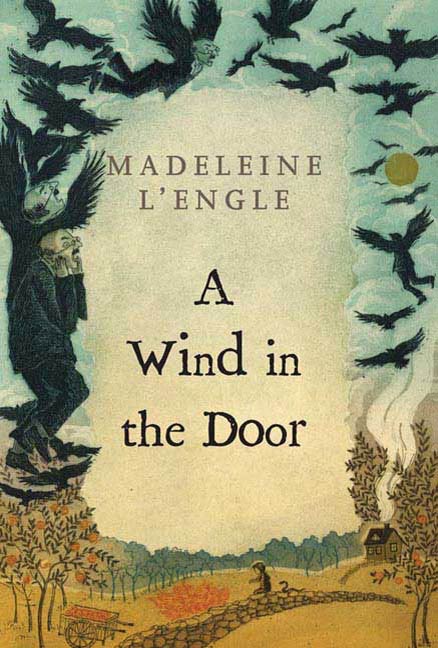
A Wind in the Door
by Madeleine L'Engle · Time Quintet #2
L'Engle's literary sci-fi sequel to A Wrinkle in Time, where love is the cosmic technology and a sick little brother is the universe.
The story
When Charles Wallace announces he has seen dragons in the vegetable garden and then begins to fall mysteriously ill, Meg Murry finds herself drawn into a cosmic crisis that requires her to face down a hostile principal, befriend a being made of wings and eyes, and learn what it really means to Name another person. A patient, philosophically rich middle-grade novel about love as the force that holds the universe together.
Age verdict
Best read at 10-13 for the first time, with curious nine-year-olds welcome and teens still finding new layers; younger or more impatient readers may need an adult reading partner.
Our take
literary_growth_book
What stands out
Each audience's top 3 dimensions. Out of 30 scored per book.
Kids love
- Heart-punch Exceptional
Comparable to City Spies , triangulated with emotional structure — Meg's love for Charles Wallace is the emotional engine; bullying plus helpless worry hit hard; sustained spiritual tenderness in late chapters. Sits above.
- Plot unpredictability Exceptional
Comparable to Artemis Fowl , triangulated with plot unpredictability — Cherubim made of wings/eyes, hostile principal matters far more than expected, journey inward into single cell (not outward to planet). Sits at/near 10: almost nothing unfolds as predicted.
Parents love
- Vocabulary builder Exceptional
Comparable to A Snicker of Magic , triangulated with vocabulary depth — Mitochondria, farandolae, cherubim, propitiate, ontological plus coined terms (kything, Naming); 790L with consistently elevated diction. Sits above: vocabulary in service of philosophical meaning-making.
- Writing quality Exceptional
lyrical without precious, philosophically dense without lecturing, cosmic vision from single page; durable generational writing. Sits at 9: Newbery-adjacent literary craft.
Teachers love
- Mentor text quality Exceptional
Comparable to Alma and How She Got Her Name , triangulated with craft modeling depth — Models weaving abstract ideas into concrete scenes, non-human character voice conveys feeling, domestic setting as launchpad for cosmic stakes. Sits above: character voice craft more sophisticated.
- Cross-curricular value Exceptional
Comparable to A Tale Dark and Grimm , triangulated with science depth — Plot drops into cells/mitochondria science unit, supports philosophical/ethics conversations, art/drama/creative-writing extensions; Kennedy Center has lessons. Sits above: actual cell biology.
✓ Perfect for
- • thoughtful readers who loved A Wrinkle in Time and want more of the Murry family
- • kids drawn to literary fantasy with real ideas
- • young readers comfortable with quieter, philosophical pacing
- • families looking for a sibling-love story with cosmic stakes
Not ideal for
Action-first readers who want fast plotting and frequent humor — the middle of the book is contemplative rather than propulsive, and there are no laughs or gags to power readers through the slow stretches.
⚠ Heads up
At a glance
- Pages
- 224
- Chapters
- 12
- Words
- 49k
- Lexile
- 790L
- Difficulty
- Moderate
- POV
- Third Person Limited
- Illustration
- None
- Published
- 1973
- Publisher
- Square Fish (Macmillan)
Mood & style
You'll know it worked when…
moderate
More like this
Same genre, similar age range. Ranked by kid score.
Harry Potter and the Philosopher's Stone
by J.K. Rowling
Bone #4: The Dragonslayer
by Jeff Smith
Wings of Fire: The Hidden Kingdom
by Tui T. Sutherland

The Neverending Story
by Michael Ende
Want more picks like this?
Get 5 hand-picked book reviews for your child's age — one email a month.