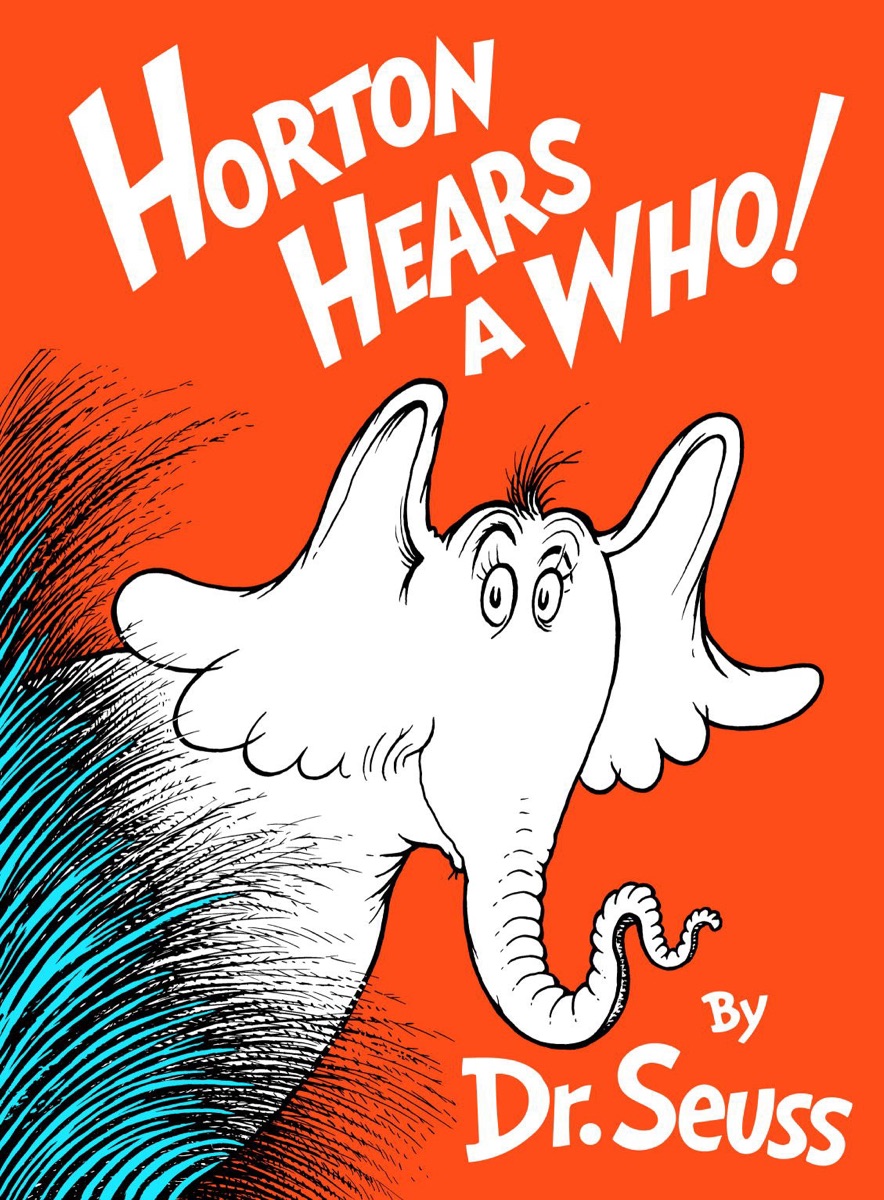
Horton Hears a Who!
by Dr. Seuss
A masterclass in compassion that teaches children every voice matters — told in unforgettable Seussian verse.
The story
When Horton the elephant hears a tiny voice coming from a speck of dust, he discovers an entire civilization of tiny people called Whos. Despite mockery and active sabotage from the other jungle animals, Horton protects the Whos with unwavering determination. When the Whos face destruction, they must make themselves heard — and it takes every single voice, including the smallest, to prove they exist.
Age verdict
Best for ages 4-7 as a read-aloud or early independent read. The moral resonance extends to all ages — adults find new meaning in repeated readings.
Our take
A teacher's treasure that works across all three perspectives. Strong classroom utility (T1=10 read-aloud) and deep craft (P2=9 writing quality) combined with solid kid engagement (K9=8 cultural quotability). The teacher-favored gap reflects this book's extraordinary pedagogical value.
What stands out
Each audience's top 3 dimensions. Out of 30 scored per book.
Kids love
- Ending satisfaction Strong
Something Wonky This Way Comes — The final pages deliver complete resolution: Horton is vindicated, the Whos are safe, the Kangaroo becomes protector, and the opening refrain is embodied by the character who denied it. Sits at anchor because like Mercy Watson, every thread resolves decisively without loose ends, and the close feels earned and emotionally satisfying.
- Playground quotability & cool factor Strong
Comparable to Mockingjay, triangulated with Artemis Fowl — 'A person's a person' has become a real-world rallying cry in social justice contexts; 'YOPP!' is iconic playground language; the film extends cultural reach. Sits at 8 (below Mockingjay/10) because while the phrase has activism potential, Horton operates as inspirational but not directive; it affirms rather than mobilizes. Comparable to Artemis Fowl's conceptual cool (twelve-year-old conducting criminal operations) in reach and playground currency.
Parents love
- Writing quality Exceptional
Unicorn of the Sea!, triangulated with Charlotte's Web — Seuss's verse demonstrates mastery of musicality, economy, and thematic integration at the sentence level. Every line serves multiple functions. The refrain technique rivals Charlotte's vocabulary as a 'secret curriculum.' Sits at 9 because while Charlotte's Web sustains sophisticated vocabulary and sentence rhythm across 184 pages, Horton's achievement is compression rather than expansion—extraordinary mastery within a fixed format constraint. The intensity of craft per page equals 10, but the book's brevity limits the range of demonstrated technique.
- Moral reasoning Strong
Comparable to Artemis Fowl, triangulated with A Tale Dark and Grimm — The epistemological question—what counts as proof of existence?—is genuinely sophisticated. Should we believe things we cannot see? Is collective disbelief evidence? The Kangaroo's journey from dismissal to protection teaches that moral understanding requires direct experience. Sits at 8 because unlike Dark and Grimm (which poses questions without answers), Horton offers a satisfying moral resolution while still requiring young readers to grapple with the underlying reasoning. The moral architecture is cleaner but equally meaningful.
Teachers love
- Read-aloud power Exceptional
Horton's earnest repetition, the Kangaroo's dismissive 'Humpf!' The refrain invites class call-and-response participation. The climactic 'YOPP!' brings physical participation. Sits at anchor because this may be the exemplary picture-book read-aloud—every structural element from verse rhythm to character voices to participatory moments is optimized for performance.
- Classroom versatility Strong
Comparable to A Wolf Called Wander — Works as read-aloud (verse performance), mentor text (refrain technique, character voice), discussion text (moral reasoning, evidence and belief), creative writing prompt, and cross-curricular anchor (civics, ethics, science). A teacher can build a full multi-day unit from this single book. Sits below anchor because while A Wolf Called Wander's month-long ecosystem unit exceeds Horton's week-long coverage, Horton's versatility across multiple learning modalities is genuine and robust.
✓ Perfect for
- • children ages 4-7 who love rhyming stories
- • families wanting to discuss compassion and standing up for others
- • classroom read-alouds during Read Across America
- • parents seeking books about kindness and moral courage
Not ideal for
Children seeking action-heavy adventure or chapter-book length stories. The verse format and picture book length may feel too short for independent readers over age 8 who prefer longer narratives.
At a glance
- Pages
- 64
- Chapters
- 1
- Words
- 2k
- Lexile
- 600L
- Difficulty
- Easy
- POV
- Third Person Omniscient
- Illustration
- Fully Illustrated
- Published
- 1954
- Publisher
- HarperCollins Children's Books
- Illustrator
- Dr. Seuss
- ISBN
- 9780007455942
Mood & style
You'll know it worked when…
Most children will want this read again immediately upon finishing. The verse rhythm and satisfying resolution create strong re-read demand.
More like this
Same genre, similar age range. Ranked by kid score.


Want more picks like this?
Get 5 hand-picked book reviews for your child's age — one email a month.