
Emmanuel's Dream
by Laurie Ann Thompson
A true story of one boy, one leg, and 400 miles that changed a country.
The story
Emmanuel was born in Ghana with one deformed leg. Most of his village thought he was cursed. His mother Comfort thought otherwise. In spare, near-verse prose paired with Sean Qualls's mixed-media art, Laurie Ann Thompson traces Emmanuel's journey from hopping two miles to school each day, to working at thirteen in Accra to support his family, to bicycling nearly 400 miles across Ghana to prove 'disability does not mean inability.' A Schneider Family Book Award winner; short enough to read in one sitting; layered enough that 5-year-olds hear the rhythm, 10-year-olds hear the disability-rights argument.
Age verdict
Best for ages 6-9 as read-aloud; independently readable by strong grade-3-4 readers. Younger children can handle it with adult support.
Our take
literary_award_winner
What stands out
Each audience's top 3 dimensions. Out of 30 scored per book.
Kids love
- Heart-punch Strong
Mama Comfort's Christmas-Eve deathbed instructions followed by her Christmas-morning death in a single page turn is one of the most technically exact emotional beats in any picture-book biography — the reader experiences both her blessing and her absence in one breath. The unadorned delivery ('By the next morning, Emmanuel's beloved mother was dead.') hits harder than most fantasies twice its length. Approaches A Long Walk to Water (9) in restraint but briefer in sustained grief.
- Ending satisfaction Strong
The 400-mile ride completed, the hero returning to Accra, people with disabilities 'some for the very first time' coming outside, and the thesis 'one person is enough to change the world' — the closing pages deliver a triumph earned by every prior spread. Author's Note extends the win with the 2006 Persons with Disability Act. Stronger than most picture-book resolutions; stops short of the emotional reverberation of Last Stop on Market Street (9).
Parents love
- Writing quality Exceptional
Near-verse cadence in prose clothing — cascading lineation, triadic lists ('a sharp mind, a bold heart, and one strong leg'), restraint at the emotional peak (mother's death in one unadorned sentence). The opening inventory is a textbook example of rhythmic rupture. Schneider Family Book Award-winning craft; sits at Illuminae-level mastery of voice for picture books, beneath Narwhal-level (10) consistency of dialogue craft.
- Stereotype-breaker Exceptional
Centers a Black Ghanaian boy with a physical disability as agentic protagonist — not object of pity, not inspiration-porn token. The book explicitly names the stereotypes ('useless,' 'cursed,' 'beggar') and stages their refutation scene by scene (soccer ball, shopkeeper, THE POZO reclamation). Stronger than Gathering Blue's margin-as-perspective (8) approach; approaches Legendborn-level (10) systematic dismantling but in the compressed form picture books allow.
Teachers love
- Read-aloud power Exceptional
Verse-prose hybrid with cascading lineation — designed for oral delivery. The opening inventory invites rhythmic recitation; the 'He pedaled through rain forests, over rolling hills, and across wide, muddy rivers' anaphora begs choral response. Page-turn engineering at the bike-learning moment ('but finally … / he rode!') works live in a way few picture books achieve. Near Sylvester and the Magic Pebble (9, naturally speakable prose) for picture-book read-aloud quality.
- Mentor text quality Exceptional
Three distinct teachable moves in one 40-page book: the opening inventory ('one detail disrupts the rhythm'), the anaphoric ride montage (list-structures for escalation), and Mama Comfort's four-imperative deathbed line (high-stakes dialogue with zero adornment). Rarely does a picture-book biography offer this density of craft demonstrations — comparable to Alma and How She Got Her Name for name-origin mentor texts, stronger for sentence-level restraint.
✓ Perfect for
- • children curious about real-life heroes
- • families discussing disability inclusion
- • classrooms exploring Ghana or West Africa
- • read-aloud sessions that invite choral response
- • social-justice picture-book collections
Not ideal for
Families avoiding parental-death content with young children, or readers seeking light/humorous fare — the tone is reverential throughout.
⚠ Heads up
At a glance
- Pages
- 40
- Chapters
- 9
- Words
- 1k
- Lexile
- AD770L
- Difficulty
- Moderate
- POV
- Third Person Limited
- Illustration
- Fully Illustrated
- Published
- 2015
- Illustrator
- Sean Qualls
Mood & style
You'll know it worked when…
40 pages, one sitting — a strong Book-Fair one-read pickup and a natural all-school-read.
More like this
Same genre, similar age range. Ranked by kid score.
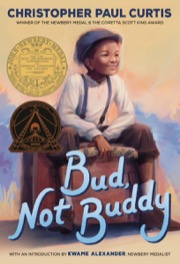
Bud, Not Buddy
by Christopher Paul Curtis
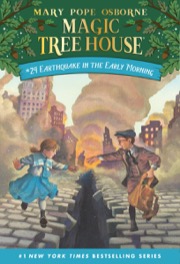
Earthquake in the Early Morning
by Mary Pope Osborne
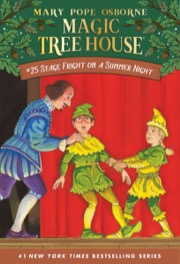
Stage Fright on a Summer Night
by Mary Pope Osborne
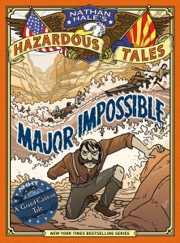
Major Impossible (Nathan Hale's Hazardous Tales #9)
by Nathan Hale
Want more picks like this?
Get 5 hand-picked book reviews for your child's age — one email a month.