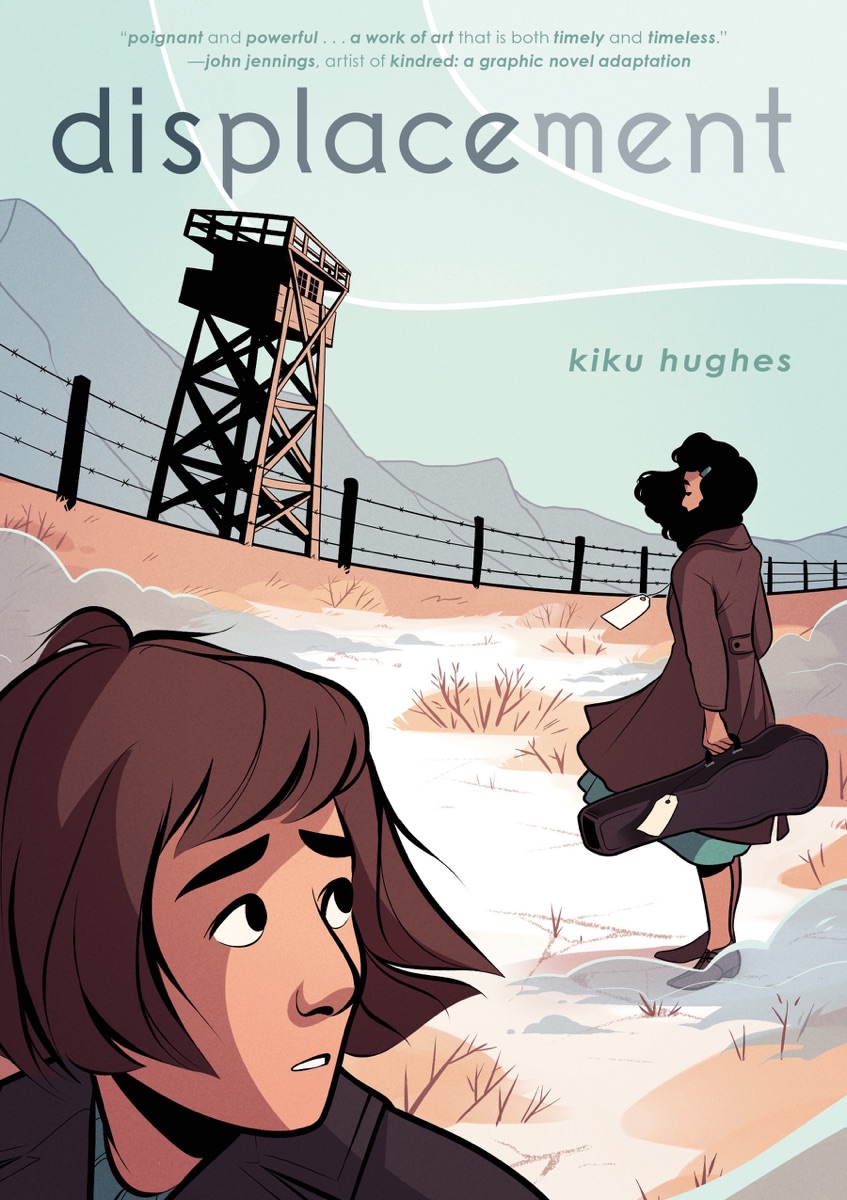
Displacement
by Kiku Hughes
A powerful graphic novel that transforms Japanese-American internment history from textbook knowledge into lived emotional experience
The story
When sixteen-year-old Kiku visits San Francisco with her mother, she begins experiencing mysterious displacements that transport her back to the 1940s Japanese-American internment camps where her grandmother was held. As she navigates life in the camps, Kiku discovers her family's hidden history, forms a meaningful connection with a girl named May, and comes to understand how inherited trauma and resilience shape identity across generations.
Age verdict
Best for ages 12-15. Mature 10-11 year olds can engage with parent support. The LGBTQ content is handled naturally and age-appropriately. Historical content includes period-appropriate language and references to state-sanctioned injustice.
Our take
A teaching powerhouse and parent-approved historical graphic novel that sacrifices kid entertainment value (low humor, no playground currency) for exceptional educational depth, emotional sophistication, and real-world relevance. The kid scorecard shows strong engagement through emotional investment rather than fun.
What stands out
Each audience's top 3 dimensions. Out of 30 scored per book.
Kids love
- Heart-punch Strong
displacement moment (pages 35-40, wonder-panic mixture), grandmother recognition (pages 120-130, profound connection), and reunion-reconciliation (pages 250-260, bittersweet devastation). Each earned through sustained character investment across 50-130 pages. Visual storytelling deepens impact (color shifts, hand-holding across time). Sits at the anchor: both deliver earned emotional architecture across full narrative.
- Ending satisfaction Strong
Something Wonky This Way Comes — ending integrates every narrative thread: Kiku returns transformed from displacement, carrying forward grandmother's story and new self-understanding. Contemporary epilogue framing (news coverage) adds urgency without undermining emotional resolution. Readers feel the journey was worth the difficulty. Sits at the anchor: both resolve all threads with meaningful emotional integration.
Parents love
- Stereotype-breaker Exceptional
Comparable to Gathering Blue — Kiku presented as neither passive victim nor superhero, but as complex young person (curious, confused, brave, authentically imperfect). The LGBTQ romantic subplot is normalized without fanfare or trauma-centering. Camp residents shown as full human beings with humor, dignity, and agency rather than historical abstractions. Book actively counters historical erasure of Japanese-American narrative agency. Sits at the anchor: both systematically dismantle dehumanizing stereotypes.
- Real-world window Exceptional
Comparable to Blended — major historical window into Japanese-American internment — one of the most significant and under-taught chapters of American history. Readers learn about Executive Order 9066, assembly centers, relocation camps, and long-term community impact. Contemporary epilogue connects historical internment to modern detention and family separation policies, adding urgent real-world relevance. Sits at the anchor: book IS a real-world window.
Teachers love
- Cross-curricular value Exceptional
Comparable to A Wolf Called Wander — connects robustly across US History (Executive Order 9066, WWII home front), Social Studies (civil rights, government authority, minority community experience), Art (visual storytelling, graphic novel craft, color theory), Current Events (contemporary detention, family separation), SEL (empathy, identity, inherited trauma). Natural hub for interdisciplinary units spanning history, civics, art, SEL. Sits at the anchor: rich cross-curricular throughlines.
- Discussion fuel Exceptional
Was internment justified by security concerns? What responsibility for historical injustices? How does family history change identity? Can art serve as historical testimony? Students bring personal experiences, family heritage context, genuine disagreements. Debate is intellectual not performative. Sits at the anchor: both create authentic intellectual friction.
✓ Perfect for
- • Readers who connect with historical fiction told through personal stories
- • Graphic novel enthusiasts seeking meaningful content beyond superhero narratives
- • Families wanting to explore Japanese-American history together
- • Young readers curious about their own family heritage and cultural identity
Not ideal for
Readers seeking action-driven adventure or lighthearted entertainment. The emotional weight and historical gravity require readiness for serious subject matter.
⚠ Heads up
At a glance
- Pages
- 256
- Chapters
- 4
- Words
- 8k
- Difficulty
- Moderate
- POV
- First Person
- Illustration
- Fully Illustrated
- Published
- 2020
- Publisher
- First Second
- ISBN
- 9781250193537
Mood & style
You'll know it worked when…
Most readers finish in 1-2 sittings. The visual format and emotional momentum sustain engagement despite the serious subject matter.
More like this
Same genre, similar age range. Ranked by kid score.


Want more picks like this?
Get 5 hand-picked book reviews for your child's age — one email a month.