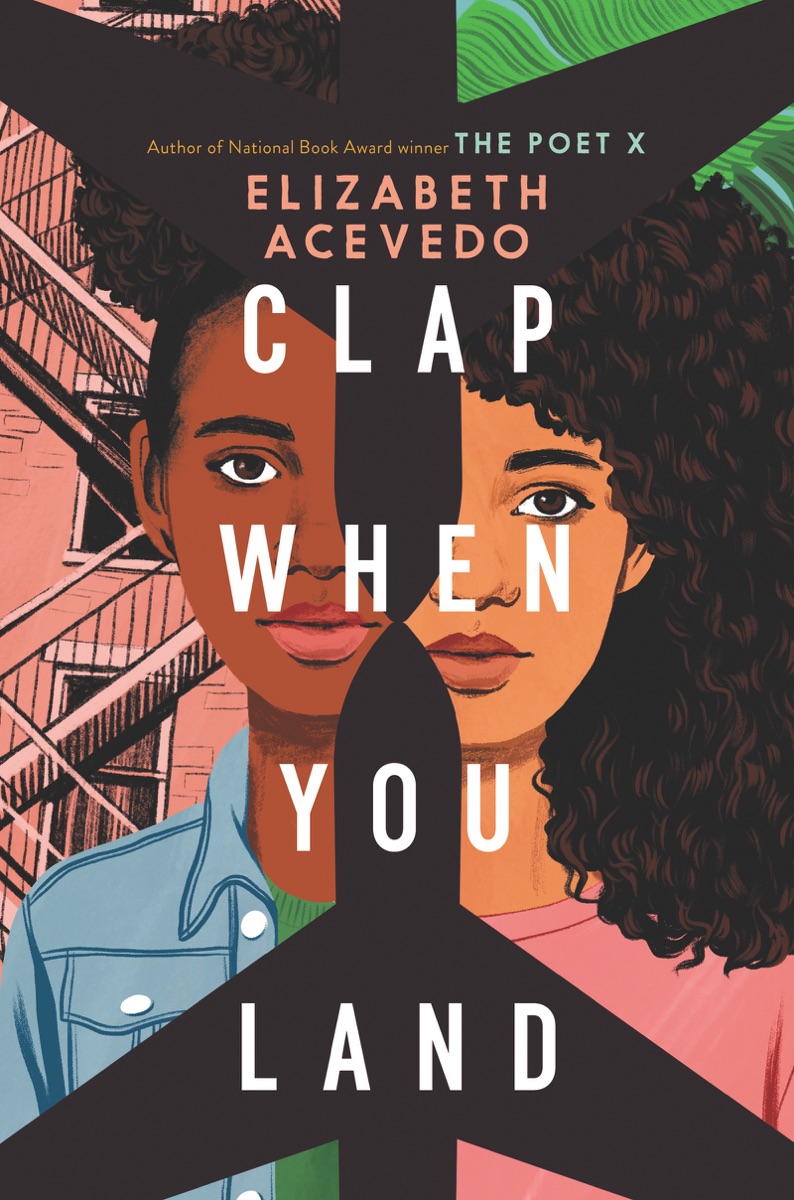
Clap When You Land
by Elizabeth Acevedo
A devastating verse novel about two sisters who discover each other after losing their father
The story
When a plane crashes on a flight from New York to the Dominican Republic, two teenage girls on opposite sides of the ocean learn they've lost their father — and discover they are not alone in their grief. Told in alternating verse perspectives, the novel follows both girls through thirty-one days of mourning, revelation, and the tentative first steps toward an unexpected connection.
Age verdict
Best for ages 13-17. Mature themes (parental loss, sexual harassment, family deception) require emotional readiness, but the verse form makes it accessible to strong readers as young as 12.
Our take
Literary powerhouse with exceptional emotional depth and craft; strongest for parents and teachers who value writing quality, representation, and discussion potential; weaker on kid entertainment metrics (humor, visual immersion, cool factor) because the book prioritizes emotional truth over fun.
What stands out
Each audience's top 3 dimensions. Out of 30 scored per book.
Kids love
- Character voice Exceptional
Two radically distinct verse voices — Yahaira thinks in chess logic, analytical metaphors, and controlled syntax; Camino thinks in ocean imagery, sensory experience, and spiritual rhythm. A reader could identify each narrator without labels. Stronger than City Spies (9, five distinct speakers) because the verse form elevates voice from dialogue pattern to worldview architecture; not quite Children of Blood and Bone (10, three visceral narrators) because two voices vs. three, but the code-switching between English and Spanish adds a dimension no prose novel matches.
- Heart-punch Exceptional
Multiple devastating emotional peaks built through accumulated craft: a quiet moment of physical tenderness between Yahaira and her girlfriend that breaks through weeks of suppressed grief, the weight of unanswered questions about a father who can never explain himself, and the slow recognition that silence can be its own form of loss. The emotional architecture rivals A Court of Mist and Fury (9, devastating earned across dozens of chapters) — each peak is prepared by verse-form restraint that makes the release devastating. The book models grief as communal, messy, and non-linear rather than tidy.
Parents love
- Writing quality Exceptional
Acevedo's verse craft is genuinely literary — line breaks create meaning, not decoration. The moment 'No survivors found. The number of dead: / all of them' uses white space as devastation. Boston Globe-Horn Book Award and Odyssey Award confirm literary recognition. Comparable to Illuminae (9, mastery of voice at sentence level) in how form serves content perfectly. The dual-voice architecture — Yahaira's analytical compression vs. Camino's sensory expansiveness — demonstrates the highest level of controlled craft.
- Stereotype-breaker Exceptional
Multiple conventions broken simultaneously: a queer Latinx protagonist whose sexuality is affirmed not problematized, a Dominican father whose complexity resists both villain and saint framing, a Caribbean community shown with spiritual richness rather than poverty porn, and grief modeled as communal rather than private. Comparable to Gathering Blue (9, disabled protagonist whose limitation is never framed as something to overcome). The book refuses to explain or translate its Latinidad — an act of narrative respect that breaks the assumption that diverse stories must educate white readers.
Teachers love
- Read-aloud power Exceptional
Written by a slam poet, the verse is inherently performable — natural pauses at line breaks, rhythmic variation between Yahaira's clipped syntax and Camino's flowing imagery, and emotionally charged passages that demand vocal expression. Comparable to Sylvester and the Magic Pebble (9, designed for oral delivery with elegant sentence variation). Individual poems work as standalone read-aloud pieces. The dual-voice structure invites two-reader performance, creating classroom engagement that prose novels cannot match.
- Mentor text quality Exceptional
The verse form is a masterclass in craft techniques: line breaks for meaning, white space as emotional tool, voice differentiation through syntax, code-switching as narrative device, and parallel structure across dual narratives. Each chapter functions as a self-contained mentor text. Comparable to 5 Worlds Book 1 (9, multiple visual craft techniques are teachable). Teachers can isolate individual poems to teach specific skills — metaphor, voice, pacing — without assigning the full novel. Acevedo's spoken-word background makes craft choices intentional and teachable.
✓ Perfect for
- • Teens processing grief or family upheaval
- • Readers who love verse novels and poetic language
- • Anyone interested in Dominican-American identity and culture
- • Fans of dual-perspective storytelling
- • Readers who want emotionally complex, award-winning YA
Not ideal for
Readers seeking action, humor, or fantasy escapism — this is a deeply emotional literary novel that sits with grief rather than providing distraction from it.
⚠ Heads up
At a glance
- Pages
- 432
- Chapters
- 18
- Words
- 63k
- Lexile
- 800L
- Difficulty
- Challenging
- POV
- Alternating
- Illustration
- None
- Published
- 2020
- Publisher
- HarperTeen
- ISBN
- 9780062882769
Mood & style
You'll know it worked when…
Readers should be able to discuss family secrets, grief, and forgiveness with some nuance. If a teen has experienced loss or family complexity, this book will feel like recognition.
More like this
Same genre, similar age range. Ranked by kid score.



Want more picks like this?
Get 5 hand-picked book reviews for your child's age — one email a month.