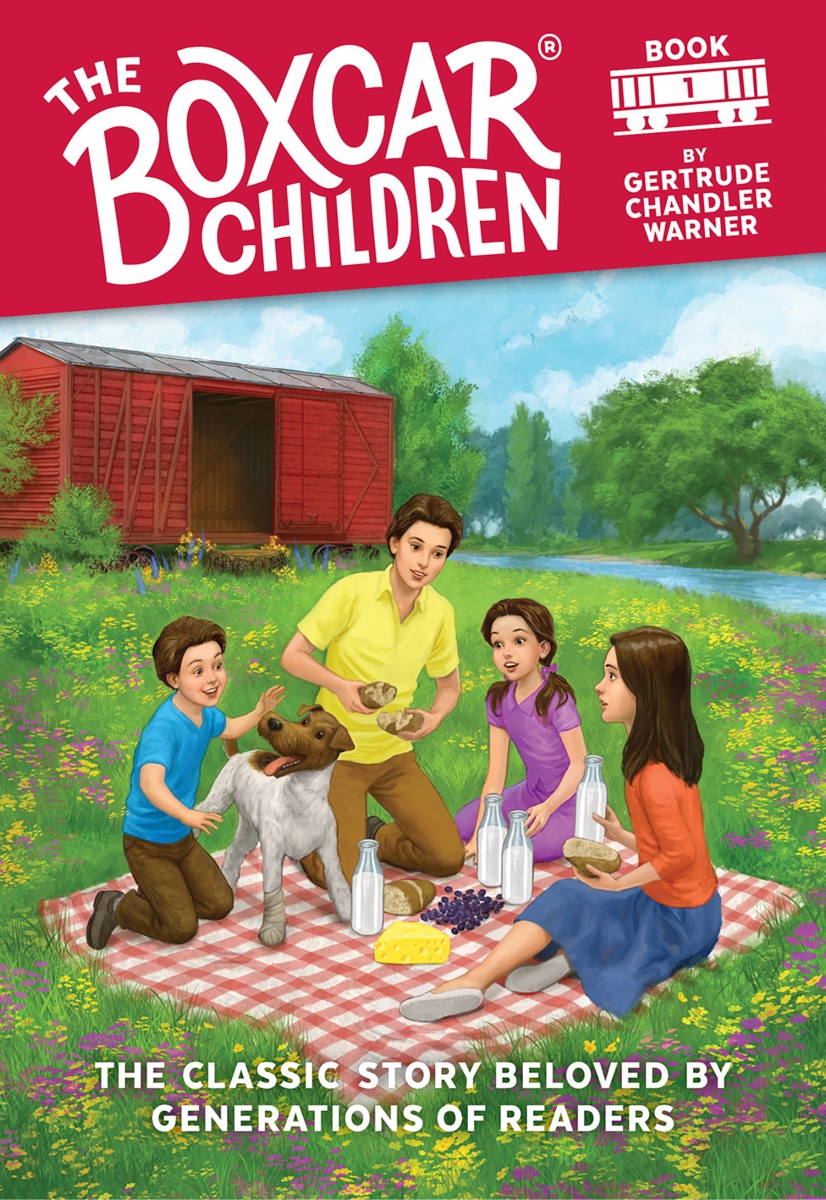
The Boxcar Children
by Gertrude Chandler Warner · The Boxcar Children Mysteries #1
Four orphaned siblings turn an abandoned boxcar into a home — the ultimate kid-independence fantasy
The story
After their parents die, four siblings — Henry, Jessie, Violet, and Benny — run away rather than live with a grandfather they've never met. They discover an abandoned boxcar in the woods and transform it into a surprisingly cozy home, solving everyday problems through teamwork and resourcefulness. But how long can four children live on their own?
Age verdict
Best for ages 6-9; the simple vocabulary and short chapters make it ideal for early independent readers, while the independence premise keeps older kids engaged through about age 11.
Our take
A classic gateway book that teachers love for reluctant readers, with a cozy premise that outperforms its simple prose
What stands out
Each audience's top 3 dimensions. Out of 30 scored per book.
Kids love
- Ending satisfaction Strong
all children safe, grandfather accepting, home secured, Watch kept, boxcar preserved. Every thread resolves completely without cheap sentiment.
- Heart-punch Strong
emotional core engineered across entire arc. Children creating safety, fear of separation, quiet courage through action. Triangulated with Tristan Strong and City Spies . Emotional weight lighter than Tristan but architecturally complete: fear → competence → reunion → safety. Sits at 7.
Parents love
- Reading gateway Strong
Comparable to A Bear Called Paddington and Frog and Toad Together — one of great gateway chapter books. Short chapters, simple vocabulary, high-interest premise, massive series (150+ books). Accessibility-to-engagement ratio outstanding. Slightly narrower grade range (2-5) but comparable gateway impact.
- Creative spark Strong
fort-building, survival-scenario imagination. Tier 3 escalation: candidate shift 6→7. Triangulated with The Boy at the Back and Mercy Watson . Practical problem-solving fuels sustained creative play. Sits at 7.
Teachers love
- Read-aloud power Strong
high-stakes attribute. Chapters brief enough for single sessions. Triangulated with Gathering Blue (T1=8, rhythmic variation) and Be Careful . Confirms 7.
- Classroom versatility Strong
read-aloud, guided reading, independent reading, literature circles. Simple text with rich thematic content allows different analytical depths.
✓ Perfect for
- • Early independent readers (grades 2-4) ready for their first real chapter book
- • especially kids who love building forts
- • survival stories
- • or imagining life without grown-ups. Also excellent for reluctant readers who need a low-barrier
- • high-interest entry point.
Not ideal for
Readers seeking fast-paced action, plot twists, humor-driven stories, or complex characters — this is a quiet, cozy book with a gentle pace and simple prose.
⚠ Heads up
At a glance
- Pages
- 154
- Chapters
- 13
- Words
- 17k
- Lexile
- 580L
- Difficulty
- Easy
- POV
- Third Person Omniscient
- Illustration
- Sparse
- Published
- 1942
- Publisher
- Random House Books for Young Readers
- Illustrator
- L. Kate Deal
- ISBN
- 9780807508527
Mood & style
You'll know it worked when…
Very high completion rate — short chapters, simple text, and the constant question of whether the children will be discovered create steady forward pull even for struggling readers.
More like this
Same genre, similar age range. Ranked by kid score.
Millionaires for the Month
by Stacy McAnulty

Insignificant Events in the Life of a Cactus
by Dusti Bowling

The Season of Styx Malone
by Kekla Magoon

EllRay Jakes Is Not a Chicken
by Sally Warner
Want more picks like this?
Get 5 hand-picked book reviews for your child's age — one email a month.