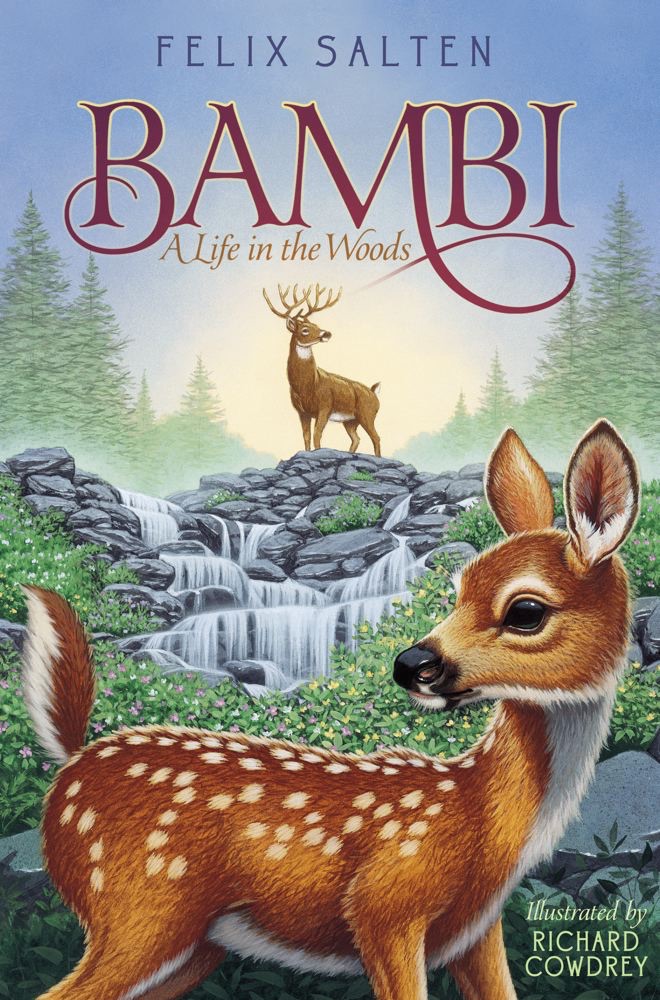
Bambi
by Felix Salten · Bambi #1
A literary masterpiece about growing up in a dangerous world — far deeper and darker than the Disney film
The story
A young deer is born in a forest clearing and grows up discovering the beauty and terror of the natural world. Through encounters with other animals, first love, rivalry, and the ever-present danger of human hunters, he gradually learns that survival requires both courage and solitude. Guided by a mysterious elder, he must find his own path from innocence to wisdom.
Age verdict
Best for ages 10-12. Younger readers may enjoy the animal world but will miss much of the philosophical depth. The emotional content (loss, violence, mortality) requires some maturity to process without distress.
Our take
A literary classic that parents and teachers value far more than kids initially enjoy — rich in craft, emotional depth, and discussion material, but its contemplative pace and philosophical darkness limit kid appeal.
What stands out
Each audience's top 3 dimensions. Out of 30 scored per book.
Kids love
- Heart-punch Strong
Comparable to Earthquake in the Early Morning — Multiple emotional peaks across second half (Ch14 realization, Ch27 shooting, Ch31 farewell). Conveyed through restraint and physical detail rather than stated feeling. Accumulated force of loss builds genuine, lingering grief that persists after reading. Emotional architecture is earned.
- Mental movie Strong
named wildflowers (avellanos), detailed forest canopy light patterns, dawn sounds of forest ecosystem. Botanical precision combined with emotional atmosphere creates scenes reader can see/hear/smell with cinematic clarity. Mastery of sensory design.
Parents love
- Writing quality Exceptional
sensory descriptions precise without overwriting, emotional moments conveyed through silence and physical detail rather than stated feeling, masterful control of pacing using sentence length to modulate tension. Mastery of narration and description; sentence-level craft is exceptional.
- Moral reasoning Strong
cost of safety versus freedom, whether distance equals care, who bears responsibility when trust is misplaced. Old prince's isolation teaching creates moral ambiguity. These dilemmas require genuine moral reasoning from reader.
Teachers love
- Mentor text quality Strong
opening birth scene as exercise in creating immediate intimacy, meadow description as model of sensory writing, use of sentence length variation to control emotional pacing, restraint technique of conveying grief through physical detail rather than stated emotion.
- Discussion fuel Strong
Was captive character foolish or brave? Is old prince's isolation wisdom or emotional avoidance? Is ending hopeful or tragic? Students can hold opposing positions with textual evidence supporting each view.
✓ Perfect for
- • Children who love nature and animals
- • Families looking for a book with genuine emotional and philosophical depth
- • Readers ready for a literary classic that treats them as thoughtful people
- • Kids who enjoyed Charlotte's Web and are ready for something more challenging
Not ideal for
Children who need fast-paced action, humor throughout, or a consistently cheerful tone. The second half is emotionally heavy and the pacing is contemplative.
⚠ Heads up
At a glance
- Pages
- 293
- Chapters
- 31
- Words
- 65k
- Difficulty
- Challenging
- POV
- Third Person Omniscient
- Illustration
- Sparse
- Published
- 1923
- Publisher
- Simon and Schuster
- ISBN
- 9780671666071
Mood & style
You'll know it worked when…
A child who finishes this book and sits quietly for a moment has received something valuable. If they want to talk about whether the ending is happy or sad, the book has done its work.
More like this
Same genre, similar age range. Ranked by kid score.
Want more picks like this?
Get 5 hand-picked book reviews for your child's age — one email a month.