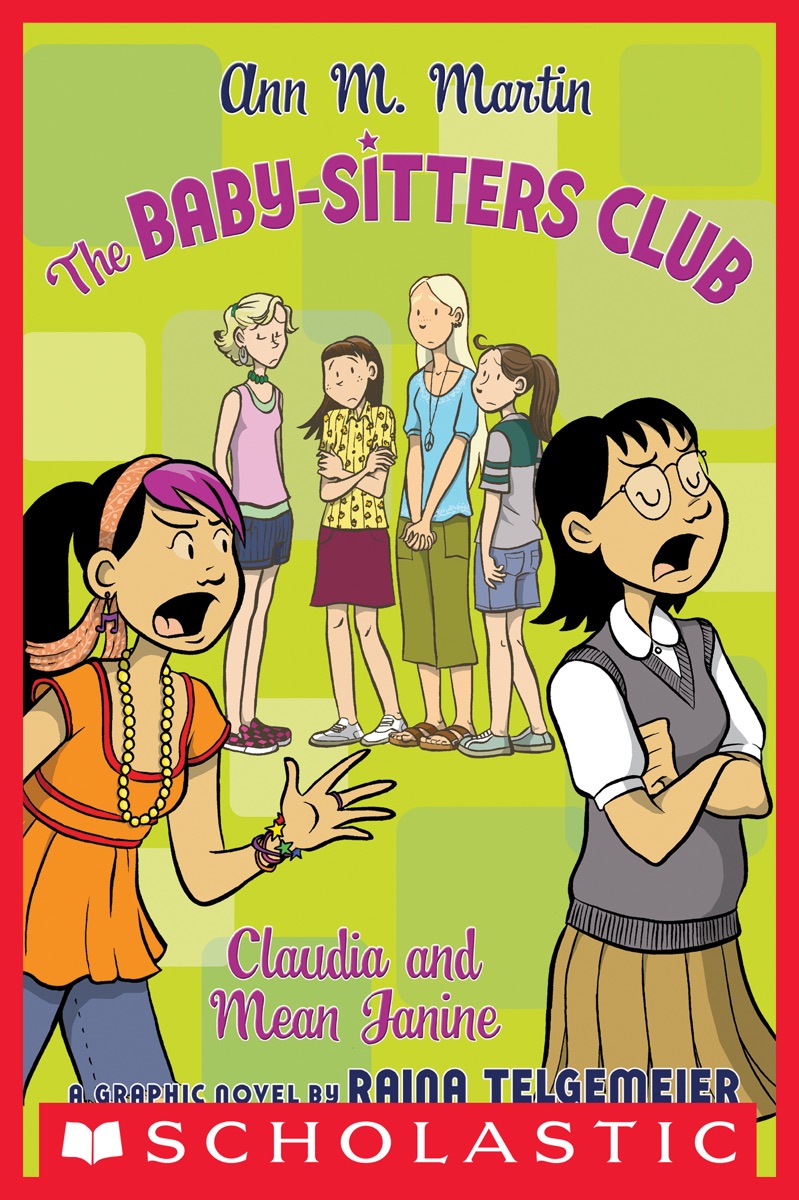
Claudia and Mean Janine: A Graphic Novel (The Baby-Sitters Club #4)
by Ann M. Martin (adapted by Raina Telgemeier) · The Baby-Sitters Club Graphix #4
A graphic novel that turns sibling rivalry into something unexpectedly moving
The story
Claudia Kishi can't stand her genius older sister Janine — she's cold, condescending, and always hiding in her room. But when a family health emergency shakes the Kishi household, Claudia starts to wonder if the sister she's labeled 'mean' might actually be hurting in ways no one noticed. A summer of babysitting, friendship, and one very honest conversation changes everything.
Age verdict
Best for ages 8-11. The graphic novel format makes it readable for 7-year-olds, but the emotional themes about family communication and a grandmother's health hit hardest for 9-11 year olds who are old enough to recognize these dynamics in their own families.
Our take
The kind of book teachers and parents value more than kids initially realize — a quiet emotional powerhouse in an accessible graphic novel format. The sophistication is relational rather than conceptual, rewarding readers who are grappling with family complexity.
What stands out
Each audience's top 3 dimensions. Out of 30 scored per book.
Kids love
- Heart-punch Exceptional
Mimi's stroke (Ch8) delivers the gut-punch, Jamie's epiphany (Ch15) unlocks empathy, Janine's confession (Ch16) recontextualizes the entire book, Claudia's guilt absolution (Ch17) provides earned warmth. The emotional architecture rivals the highest tier in earnestness and specificity. Sits just below 10 because the emotional core is sibling/family-specific rather than grief-universal, limiting some readers' resonance.
- Mental movie Exceptional
Format inherent to graphic novel. Telgemeier's full-color sequential art with expressive character faces creates cinematic visual experience. Panel composition changes with emotional register — hospital scene uses larger, slower panels; confrontation uses varied sizes for rhythmic intensity. Color coding tracks mood systematically (warm greens → cool purples → warm again). Sits at 9 because graphic novel format itself guarantees visual richness, but the illustration quality, though strong, is character-focused rather than world-immersive.
Parents love
- Stereotype-breaker Strong
Comparable to Blended — Both systemically dismantle stereotypes. Claudia is artistic but not academically ditzy; Janine is intellectually brilliant but emotionally vulnerable; Mimi retains agency and wisdom post-stroke. Japanese American family is depicted with cultural specificity (tea ritual, speech patterns, 'my Claudia') without exoticization. The book refuses easy character labels throughout. Sits at anchor because representation is specific, dignified, and integral to plot.
- Reading gateway Strong
The Sand Warrior , triangulated with A Bear Called Paddington — Tier 3 anchoring. Full-color graphic novel with expressive art, short chapters, beloved BSC brand, and substantial emotional content. Visual format eliminates reading barriers while delivering genuinely mature emotional themes — proof that accessible format supports serious storytelling. Sits at 8 rather than 10 because reluctant-reader appeal is strong but not as universal as wordless books or first-reader series.
Teachers love
- Discussion fuel Strong
Can someone seem difficult while actually feeling hurt? Do families unintentionally isolate members? What makes someone change their mind about another person? When does a child not bear responsibility for family circumstances? These questions are age-appropriate and generate genuine disagreement. Sits at 8 rather than 10 because discussion potential is strong but emotionally bounded (family-specific) rather than existential.
- Empathy & self-awareness Strong
Comparable to Amal Unbound — Both systematically build empathy through perspective-taking. Both sisters practice vulnerability and active listening in Ch16. Claudia learns to see past her frustration to another person's pain — a directly applicable social-emotional skill. Mimi's vulnerability modeling shows wisdom coexisting with physical limitation. The book is engineered as an empathy machine. Sits at anchor because the empathy arc is central to plot and character development.
✓ Perfect for
- • Kids navigating sibling relationships
- • Readers who love Raina Telgemeier's art
- • Families going through changes or health challenges
- • Reluctant readers who need an accessible entry point with emotional depth
Not ideal for
Kids looking for action, adventure, or nonstop humor — this is a quiet, emotionally rich family story. The medical emergency scenes may be intense for very sensitive younger readers.
⚠ Heads up
At a glance
- Pages
- 174
- Chapters
- 18
- Words
- 8k
- Lexile
- GN410L
- Difficulty
- Easy
- POV
- First Person
- Illustration
- Fully Illustrated
- Published
- 2008
- Publisher
- Scholastic
- Illustrator
- Raina Telgemeier
- ISBN
- 9780545886222
Mood & style
You'll know it worked when…
Most readers finish in one sitting (under 2 hours). The emotional pull after the midpoint crisis makes it hard to put down.
More like this
Same genre, similar age range. Ranked by kid score.

Want more picks like this?
Get 5 hand-picked book reviews for your child's age — one email a month.