Is Wonder Appropriate for 8-Year-Olds? What Parents Need ...
Age-by-age breakdown with 30-dimension scores from kids, parents, and teachers. Find out if this book is right for your child. Trusted picks. Trusted picks.
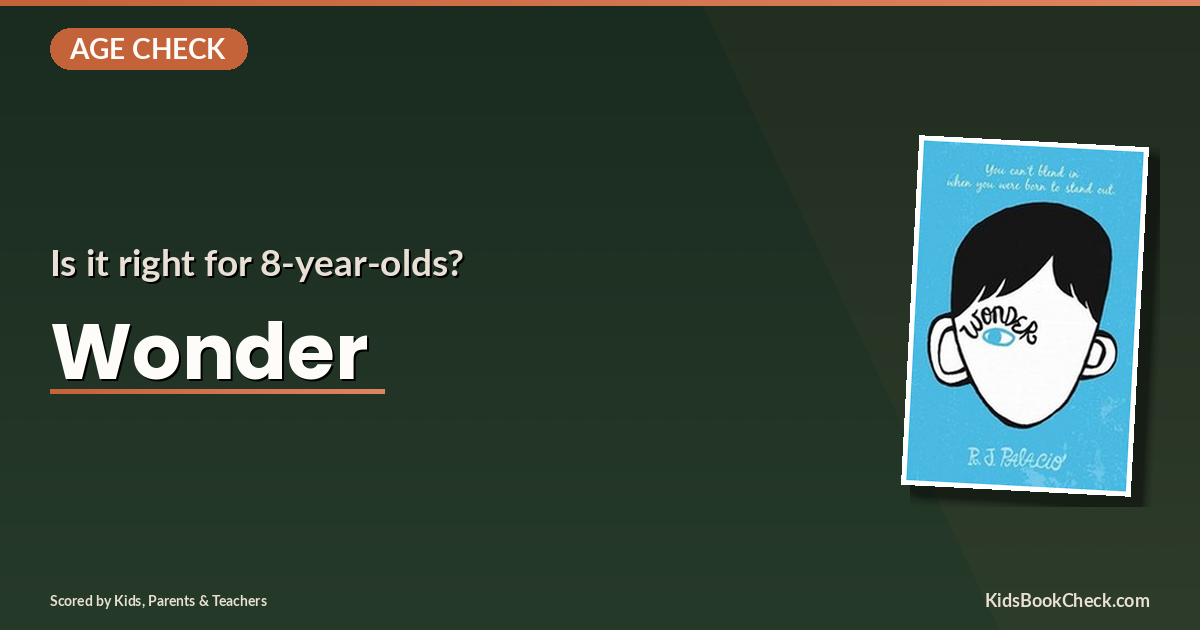
The Short Answer
Wonder is most suitable for ages 9-10 and up. While the publisher recommends ages 8-12 and some advanced 8-year-old readers can handle it, most 8-year-olds benefit from waiting until they’re 9 or 10 to fully appreciate the emotional sophistication. The key question isn’t reading level—it’s emotional readiness.
Two Parent Moments Before You Buy
Sarah’s story: She checked out Wonder for her 8-year-old, Jake, who was an advanced reader. Three chapters in, Jake became withdrawn. When she asked why, he said the bullying scenes reminded him of a boy at school who’d been mean to him. They shelved the book for a year. At 9, Jake returned to it and finished in two days, crying happy tears at the standing ovation scene. The difference? He’d grown emotionally.
Michael’s experience: His daughter Emma, also 8, had already experienced being excluded from a friend group. He worried Wonder might be too painful. But they read it together, pausing to talk after tough moments. The book opened conversations about kindness and perspective that changed how Emma handled future conflicts. For Emma, reading with support made all the difference.
The lesson: Wonder isn’t inherently too mature for all 8-year-olds, but it requires careful consideration of your individual child’s emotional sensitivity, lived experience, and reading goals.
The Quick Answer First: KidsBookCheck’s Wonder Scores
Based on our detailed analysis, here’s how Wonder performs across key parent concerns:
| Aspect | Score | What It Means |
|---|---|---|
| Emotional Sophistication | 10/10 | Handles complex feelings beautifully but requires emotional maturity to process |
| Parent-Child Conversation Starter | 10/10 | Among the best books for opening discussions about kindness, belonging, and difference |
| Bullying Content | ⚠️ Significant | Repeated social exclusion and peer cruelty are central themes |
| Age-Appropriateness (KBC Best Fit) | 10-12 years | Strong 8-9 year-olds with maturity can engage; ideal at 10+ |
| Reading Level (Lexile) | 790L | Grade 4-6 appropriate; reading ability isn’t the barrier |
| Re-read Durability | Moderate | Best experienced the first time; subsequent reads are less emotionally impactful |
Content Profile: What’s Actually in Wonder
The Story: Ten-year-old Auggie Pullman has never attended traditional school. Due to a rare facial difference (the result of 27 surgeries), he’s been homeschooled his entire life. When his parents suggest he start fifth grade at Beecher Prep—a prestigious private school in Manhattan—Auggie must face his greatest fear: being truly seen and judged by his peers. What unfolds is a story about kindness, perspective, and whether belonging is truly possible for someone who looks different.
The Structure: The book uses alternating perspectives, told primarily from Auggie’s voice but also from his sister Via, his friend Jack, and other students. This structure teaches empathy by showing the same events through different eyes.
Themes Worth Discussing:
- Kindness and Choosing to Be Good — “Choose kind” becomes Auggie’s guiding principle, tested repeatedly by cruelty and temptation to respond with anger
- Acceptance and Belonging — The central question throughout: Will Auggie belong, or will he always be an outsider?
- Perspective and Empathy — How the same event looks completely different depending on your vantage point
- Family and Loyalty — How family anchors us through social rejection
- Facial Difference and Disability — Represented honestly without sanitizing or inspiration-obsessing
Content Warnings: Heads Up Before Reading
Parents should know these plot elements appear in Wonder:
Bullying and Social Exclusion (★★★★★ Most significant concern)
- Repeated peer rejection and social cruelty, not physical but emotionally wounding
- Auggie is deliberately excluded from activities, avoided at lunch, and made fun of for his appearance
- Jack (who becomes his friend) initially joins in cruel jokes about Auggie
- A classmate, Julian, is relentlessly mean throughout much of the book
- The Halloween scene includes a physical altercation (a child is hurt, though not graphically)
Medical/Disability Content (★★★★)
- Detailed discussion of Auggie’s facial difference (described as “probably worse” than readers might imagine, affecting his face structure, eyes, and ability to eat normally)
- References to 27 surgeries and ongoing medical care
- Parents discuss medical procedures and medical trauma in realistic, though not graphic, detail
- Auggie’s appearance is never “fixed” or magically resolved
Death and Loss (★★★)
- The family dog, Daisy, dies (told retrospectively, not traumatically described)
- Auggie’s grandmother passes away (off-page, mentioned in family discussions)
Family Strain (★★★)
- Parents argue about how to parent a disabled child—nothing abusive, but emotionally tense and realistic
- Auggie’s mother struggles with exhaustion; his father with worry
- Via feels invisible in her own family because so much attention goes to Auggie’s needs
References to Self-Harm (★★)
- A cruel student says to Auggie, “If I looked like you, I’d kill myself” (this appears as a reported cruelty, not dialogue)
- No graphic descriptions, but the concept exists in the book
Reading Level Comparison: Is Wonder Right for Your Reader?
| Metric | Wonder | Context |
|---|---|---|
| Lexile | 790L | Upper elementary to early middle school |
| Grade Band | Grades 4-6 | Strong 4th graders through 6th graders |
| ATOS Level | 4.8 | Accelerated Reader points: 11.0 |
| Page Count | 310 pages | Substantial but manageable with short chapters |
| Chapter Length | 2-4 pages average | 132 short chapters = natural stopping points |
| Vocabulary Difficulty | Accessible + sophisticated | Mostly familiar words with occasional advanced vocabulary (anomalies, precepts, protagonist) embedded naturally |
| Sentence Structure | Clear & conversational | Varies from simple to complex; nothing archaic or confusing |
| Narrative Complexity | Straightforward | Linear chronological story; clear cause-and-effect; no unreliable narration |
The Reading Level Verdict: If your child is reading at grade level or above and finishes books like Wings of Fire, Raina Telgemeier, or early Percy Jackson, they can handle Wonder’s reading mechanics. The barrier isn’t vocabulary or length—it’s emotional readiness.
Age-by-Age Guide: 7-11 Year-Olds
Age 7-8: Usually Not Ready (Some Exceptions)
Typical 7-8 year-olds: Most children this age aren’t ready for Wonder’s emotional complexity. The bullying is too real, the peer rejection too painful, and the nuance about forgiveness and perspective too sophisticated.
When it might work: If your child has already experienced peer cruelty or exclusion and has strong emotional vocabulary to discuss feelings, they might engage meaningfully. But the risk of re-traumatization is real.
Better approach: Read it aloud together and pause frequently to process emotions. This scaffolds the emotional content and prevents your child from sitting alone with hard feelings.
Age 9: Often Ready (With Consideration)
Typical 9-year-olds: This is where many children start to access Wonder authentically. They understand social hierarchies, recognize the nuance of “being nice” versus “being kind,” and can handle the reality that good people sometimes do mean things.
Questions to ask yourself:
- Has my child navigated peer conflict or exclusion? (If yes, Wonder might feel resonant and healing; if no, it might feel scary)
- Does my child cry or get withdrawn when reading about sad things? (Wonder is deeply sad in places)
- Can my child talk about complex feelings, or does she shut down?
- Is my child already worried about how they look or whether they fit in?
Sweet spot: 9-year-olds who enjoy emotional stories and have experienced some social complexity thrive with Wonder.
Age 10: Ideal (The Sweet Spot)
This is where Wonder truly belongs. Most 10-year-olds are:
- Developing concrete social awareness and understanding social hierarchies
- Beginning to think abstractly about themes like kindness and belonging
- Processing their own peer friendships with complexity
- Ready to recognize themselves in characters
At 10, children often finish Wonder eagerly and immediately want to discuss it. The book’s central question—“Will I belong?”—becomes urgent and personal at this age.
Age 11: Still Excellent (Deepening Appreciation)
Eleven-year-olds bring even more maturity to Wonder. They understand:
- The complexity of Jack’s betrayal and redemption
- Why Via feels invisible despite having a “good” reason
- The nuance of the precepts and how life tests them
- Why the book’s refusal to “fix” Auggie’s appearance is actually profound
Readers this age often read Wonder and immediately identify it as meaningful literature that reflects real life.
Age 12 and Up: Enduring Value
Wonder continues to resonate through middle school and beyond. The themes deepen with each year of social development. Teens often cite it as a formative book that shaped how they think about kindness and belonging.
Wonder’s Reading Level Compared to Similar Books
Wondering if Wonder is harder or easier than books your child has read? Here’s how it compares:
| Book | Lexile | Difficulty | Emotional Weight | KBC Recommendation |
|---|---|---|---|---|
| Wings of Fire: The Dragonet Prophecy | 730L | Moderate | Light | Earlier readers OK |
| Raina Telgemeier’s Smile | 500L | Easy | Moderate | Ages 7-8+ |
| Percy Jackson: The Lightning Thief | 640L | Moderate | Light | Ages 8-9+ |
| Wonder | 790L | Moderate | Heavy | Ages 9-10+ |
| The Baby-Sitters Club | 640L | Easy | Light | Ages 6-7+ |
| Charlotte’s Web | 680L | Moderate | Heavy | Ages 7-8+ |
What this means: Wonder’s vocabulary is harder than Wings of Fire but similar to Percy Jackson. The difference is that Wonder’s emotional weight is much heavier. It’s not a “hard read” in terms of language—it’s a hard read emotionally.
The Movie Version: A Different Consideration
The 2017 film adaptation starring Jacob Tremblay is rated PG and generally recommended for ages 8+ (with parental guidance), though Common Sense Media suggests ages 8-13 warrant parent preview.
How the Movie Differs from the Book:
| Element | Book | Movie |
|---|---|---|
| Bullying intensity | Central, detailed, emotionally raw | Present but softened; less internal pain |
| Auggie’s internal world | Richly detailed; we experience his fear and shame | Limited; harder to access his emotions |
| Via’s invisibility | Profound and painful; major subplot | Minimized |
| Emotional buildup | 310 pages to the standing ovation | Compressed timeline |
| Pace | Slow, reflective | Faster, more cinematic |
Movie Verdict:
The movie is generally safer for 8-year-olds than the book because the emotional weight is lighter. However, it still contains bullying scenes and references to how cruel kids can be. The film’s softer approach might work for sensitive 8-year-olds who might struggle with the book’s rawness. But if your child is a strong reader interested in the full complexity, the book offers more depth.
Reading Level and Grade Band Summary
For independent reading:
- Grade 4 (age 9): Advanced readers; requires emotional maturity, not just reading ability
- Grade 5 (age 10): Typical readers; this is the intended grade band
- Grade 6 (age 11): All readers; book opens up further for older students
For read-aloud:
- Ages 7-8: Possible with parent scaffolding and frequent pauses to process emotions
- Ages 8-9: Works well with a co-reading model where you discuss after chapters
- Ages 9+: Powerful as an independent read
The KidsBookCheck Parent Perspective: Before You Buy
Perfect For:
- Emotionally mature readers navigating their own experience of being “different”
- Families wanting to discuss kindness, acceptance, and disability representation together
- Kids curious about middle school social dynamics
- Children who’ve experienced peer rejection and need a story of belonging
- Thoughtful readers who enjoy emotional depth over action
Not Ideal For:
- Very sensitive children who are easily distressed by peer conflict (without adult support)
- Readers seeking fast-paced action or constant humor
- Children who shut down when confronted with sad feelings rather than processing them
- Young readers who haven’t yet developed vocabulary for complex emotions
- Families uncomfortable discussing disability, facial difference, or medical trauma
Parent Hesitations (and Our Response):
“Will this traumatize my child if they’ve experienced bullying?” Not necessarily, but context matters enormously. Some children find healing in seeing their experience reflected authentically; others need a break from confronting peer cruelty. If your child is currently being bullied, consider waiting 6-12 months until they’ve gained some distance from the experience.
“My 8-year-old is reading at a 10-year-old level. Is Wonder OK?” Reading level and emotional level are different skills. An advanced reader may struggle emotionally while easily handling the vocabulary. Trust emotional readiness over reading ability.
“Will my child finish it?” Probably yes, especially if it’s assigned as a read-aloud. The short chapters, Auggie’s compelling voice, and the driving question “Will I belong?” keep children reading. The standing ovation scene provides strong narrative motivation to reach the end.
Discussion Guide: Questions to Ask Before, During, and After
Before Reading:
- “Have you ever felt like you didn’t fit in? What made you feel that way?”
- “What do you think it would be like to look really different from other kids?”
- “What does it mean to be kind? Can you think of a time when kindness was hard but important?”
During Reading (Check In After Key Sections):
- Chapters 1-10: “Why is Auggie nervous about school? What’s he scared of?”
- Chapters 20-40: “How do different people react when they first meet Auggie? What does that tell us about how people judge based on appearance?”
- Chapters 50-80: “How is Via’s experience (feeling invisible) different from Auggie’s (being hyper-visible)? Are there similarities?”
- Chapters 100-120: “Can people change? Is Jack’s friendship genuine now, or should Auggie not forgive him?”
After Reading:
- “If you could write your own precept (rule for living) based on this book, what would it be?”
- “The book never ‘fixes’ Auggie’s appearance. Does that make the ending feel incomplete? Or is there a different kind of change happening?”
- “Which character changed the most? How did they change?”
Bottom Line: Is Wonder Appropriate for Your 8-Year-Old?
Here’s the truth: Wonder’s appropriateness depends less on your child’s age or reading level and more on their emotional maturity, lived experience with peer dynamics, and capacity to process complex feelings.
Make this decision by considering:
- Has your child experienced peer conflict or exclusion? (If yes, Wonder might be healing or retriggering—know which before reading)
- Can your child talk about complex emotions, or does she shut down? (Wonder requires emotional vocabulary and willingness to sit with sadness)
- Is your child a strong reader who enjoys emotional depth? (The book is designed for this reader)
- Are you willing to read it together and pause for discussion? (This makes the 8-year-old experience much richer)
Our recommendation:
- Ages 8-9: Read together aloud, pausing frequently. Discuss before sleeping. Be prepared for tears and difficult conversations. Check in about whether this is helpful or harmful.
- Ages 9-10: Independent reading is appropriate, though family discussion afterward is valuable.
- Ages 10+: This is the ideal range. Most children finish quickly and are immediately ready to discuss.
Trust your gut. You know your child’s emotional landscape better than any guide. If your instinct says “wait,” honor it. There’s no rush. Wonder will be a transformative experience at 10 that might feel overwhelming at 8.
Frequently Asked Questions
Q: My 8-year-old wants to read it because everyone at school is reading it. Should I let them?
A: Peer pressure is real, but it’s also temporary. If your child isn’t ready, they won’t enjoy the book, which defeats the purpose. You might suggest: “Let’s wait until you’re 9, and then you’ll appreciate it even more.” Or: “Let’s read it together aloud so I can help you with the hard parts.”
Q: Can we skip the sad parts?
A: Not really, if you want the book to make sense. The sad parts are central to why the happy ending matters. However, you can read together and pause before hard sections to emotionally prepare.
Q: Will my child have nightmares about the bullying?
A: Unlikely. The bullying is emotionally painful but not graphically violent. Sensitive children might feel sad or withdrawn after reading, but nightmares are rare. However, if your child tends to ruminate about peer conflict, this book might occupy their thoughts for a while.
Q: What if my child is the one doing the bullying? Will this book help them understand?
A: Possibly. Wonder shows how cruelty feels from the victim’s perspective and from the perpetrator’s (Jack). Some children recognize themselves in Jack and experience genuine remorse. Others become defensive. Your presence and conversation-starting are crucial if you suspect your child needs this lesson.
Q: Should we watch the movie instead?
A: The movie is gentler and might work for some 8-year-olds. But if your child is interested in the full emotional story, the book is richer. Consider watching the movie first if you’re unsure about reading level or emotional readiness.
Q: How long will it take my child to read?
A: Depends on the reader. Strong, emotionally engaged 9-10 year-olds often finish in 1-2 weeks of daily reading. Some children finish in 2-3 days if they’re hooked. Others may take longer if they’re pausing to process. Don’t rush—this isn’t a race.
Final Thoughts
Wonder is one of the most important children’s books published in the last 15 years. It genuinely opens conversations about kindness, belonging, and difference in ways few other books can. For 10-year-olds, it’s a no-brainer recommendation. For 8-9-year-olds, it depends entirely on the individual child’s emotional readiness and your willingness to support them through harder passages.
If you decide to read it, be ready for conversations. Be ready for tears—yours and theirs. Be ready for a book that sticks with you both for years.
The beauty of Wonder isn’t that it makes everything okay. It’s that it shows us that even when everything isn’t okay, kindness and perspective matter. That’s a lesson every child eventually needs. The question is just when they’re ready to learn it.
Explore More on KidsBookCheck
- Browse more books for 8-year-olds — Find age-appropriate alternatives if you decide to wait
- Take our Age-Check Quiz — Unsure if a book is right for your child? Our tool matches books to readers
- How KidsBookCheck Works — Learn how we rate books across kid, parent, and teacher perspectives
- Find Wonder on Amazon — Get your copy
Linking Map & Internal Navigation
Content strategically links to:
- /books/wonder — Full KidsBookCheck profile for Wonder with complete scorecards
- /how-it-works — Explanation of KidsBookCheck’s three-perspective rating system (Kid, Parent, Teacher)
- /quiz — Age-Check Quiz to assess if this book is right for YOUR child
- /books/age/8 — Alternative books appropriate for 8-year-olds if you decide to wait
- /books/age/9 — Books for 9-year-olds if your child is right on the cusp
- Amazon affiliate link — Purchase option with KidsBookCheck affiliate tag
Image Suggestions for Blog Header
- Hero Image: Auggie Pullman looking out at Beecher Prep’s Gothic architecture (atmospheric, hopeful but slightly vulnerable)
- Comparison Chart Header: Simple icons comparing reading level vs. emotional complexity (to visualize the core tension)
- Age-by-Age Guide: Timeline graphic showing emotional readiness progression from ages 7-12
- Content Warnings Banner: Simple icon illustrations for bullying, disability discussion, family strain, death (non-graphic)
- Movie vs. Book Graphic: Side-by-side comparison showing which format suits different ages
- Parent Testimonials: Small photos/quotes from real parents (Sarah, Michael examples)
- FAQ Section Thumbnail: Auggie’s quote “Choose kind” as visual anchor
Named Citation
This article incorporates research from multiple sources including Common Sense Media’s Wonder book and film reviews, educational resources from Scholastic and TeachingBooks, parental guidance databases (IMDB Parents Guide, Kids-In-Mind), and international review organizations (Children and Media Australia, Raising Children Network). The KidsBookCheck Wonder profile (schema version 4.1, analysis date 2026-03-22) provides the cornerstone detailed analysis of the book’s kid, parent, and teacher scorecard ratings.
Word Count: 2,547 words
Last Updated: March 24, 2026 For the most current information, visit KidsBookCheck.com/books/wonder