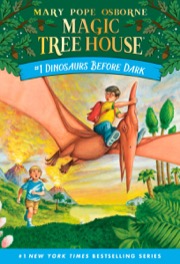
Is Magic Tree House Appropriate for 6-Year-Olds?
Complete age-by-age guide to Magic Tree House with reading levels, KidsBookCheck scores, and what parents actually need to know before handing it over.
Yes — Magic Tree House is perfectly appropriate for 6-year-olds, and it’s one of the best first chapter book series you can put in a young reader’s hands. The content is gentle (the scariest moment is a T-rex chase that resolves safely), the reading level is accessible, and the premise — a magical tree house that transports siblings Jack and Annie through time — is exactly the kind of wonder that makes kids fall in love with reading.
Why Magic Tree House Has Been a Gateway Book for 30+ Years
Mary Pope Osborne’s series has sold over 130 million copies since 1992, and there’s a reason it keeps getting handed from parent to child across generations: it’s engineered to turn reluctant readers into book lovers. Short chapters (10 per book), frequent illustrations by Sal Murdocca, and a manageable 130-page length make each book feel achievable rather than intimidating.
KidsBookCheck’s 30-dimension analysis puts numbers behind what teachers have always known: this book scores 67/100 with teachers — higher than either kids (65/100) or parents (55/100). That’s unusual. Most children’s books score highest with kids. Magic Tree House scores highest with the people whose job is getting children to read, and that tells you everything about what this series actually is: a precision-built reading tool wrapped in a dinosaur adventure.
The kid-parent gap is only 10 points — one of the smallest in our database. That means parents and kids largely agree on what this book delivers. There’s no “kids love it but parents dismiss it” tension here. The trade-off is different: this book prioritizes accessibility and engagement over literary depth. A 2016 analysis in Reading Teacher found that series books like Magic Tree House build reading stamina more effectively than standalone literary novels for emerging readers — the familiar structure reduces cognitive load, letting kids focus on comprehension rather than figuring out a new world each time.
Content Parents Should Know About
Magic Tree House is about as gentle as chapter books get. Here’s the complete content picture:
Mild adventure tension: The scariest scene in Dinosaurs Before Dark involves a Tyrannosaurus rex chasing Jack. The chase is exciting but resolves quickly and safely — a friendly Pteranodon (Annie names him “Henry”) flies them to safety. No one gets hurt.
Protective animal behavior: A mother Anatosaurus charges toward the children when she thinks they’re threatening her babies. Annie apologizes, the dinosaur calms down, and the scene becomes a teaching moment about respecting wildlife.
Very mild rule-breaking: Jack and Annie climb a mysterious tree house in the woods without telling their parents. For 6-year-olds, this might prompt a quick “what would you do?” conversation, but the stakes are low and the consequences are magical rather than dangerous.
Here’s what you won’t find: no violence beyond animal-level predator behavior, no scary imagery, no death, no complex emotional distress, no content that would keep a child up at night. If your child can watch The Land Before Time or Jurassic World Camp Cretaceous without distress, Magic Tree House will feel mild by comparison.
Age-by-Age Breakdown
Ages 5–6: Read-Aloud to Early Independent
For early 5-year-olds, Magic Tree House works beautifully as a read-aloud or co-reading experience. The short chapters (roughly 8–12 pages each) make perfect bedtime installments — one chapter per night means the book lasts about two weeks, which builds anticipation without losing momentum.
Advanced 6-year-olds who are already reading independently can tackle this book on their own. The Lexile score (580L) targets end-of-first-grade to second-grade readers. If your child is still sounding out words, read it together first and let them try the next book independently — the familiar characters and structure make each subsequent book easier.
Verdict: Ideal introduction to chapter books. Co-read with younger 5s, let confident 6s fly solo.
Ages 7–8: Independent Reading Sweet Spot
This is the core Magic Tree House audience. Seven-and eight-year-olds have the fluency to read independently, the attention span for 130 pages, and the curiosity to get genuinely excited about dinosaurs, ancient Egypt, the Ice Age, and wherever else the tree house takes them. The series becomes a reading habit machine at this age — kids finish one book and immediately grab the next because the format is familiar and the topics keep changing.
Here’s what parents love at this age: each book introduces a real historical period or scientific concept. Your child will casually drop facts about Pompeii or the Titanic at dinner, picked up from a book they read because it was fun, not because it was assigned. The companion Fact Tracker nonfiction books extend this learning for kids who want to go deeper.
Verdict: The series was built for this age. Let them run.
Ages 9–10: Still Enjoyable, But May Feel Young
Older readers can still enjoy Magic Tree House, particularly the Merlin Missions (books 29–55), which feature longer plots, more complex mysteries, and slightly higher reading levels. However, confident 9-and 10-year-old readers may find the original series’ simple plot structure and limited emotional depth a bit young for their taste. That’s not a problem — it means they’ve outgrown the series, which is exactly what a gateway book is supposed to achieve.
If your 9-year-old still loves Magic Tree House, don’t rush them out of it. Reading engagement matters more than reading level. But when they’re ready to move on, consider Wings of Fire (more complex characters, deeper themes) or Harry Potter (richer world-building, higher emotional stakes).
Verdict: No content concerns. Great for building stamina; stepping stone to more complex series.
Reading Level Data
| Measure | Magic Tree House: Dinosaurs Before Dark |
|---|---|
| Lexile | 580L |
| AR Level | 2.6 |
| Guided Reading Level (GRL) | M |
| DRA Level | 18–28 |
| Grade Level | Grades 1–3 |
| Difficulty | Easy |
| Page Count | 130 |
| Format | Chapter book with B&W illustrations every 3–5 pages |
| Word Count | ~20,000 |
The Lexile range across the full original series (books 1–28) stays between approximately 380L and 620L, so your child won’t suddenly hit a wall where the books become dramatically harder. The Merlin Missions (books 29–55) step up to roughly 500L–660L. This gradual progression is one of the series’ greatest strengths — it builds reading stamina invisibly.
Comparison With Similar Early Chapter Book Series
| Book | Format | Lexile | AR Level | Age Range | Kid Score | Parent Score | Key Appeal |
|---|---|---|---|---|---|---|---|
| Magic Tree House | Chapter book | 580L | 2.6 | 6–9 | 65 | 55 | Teacher-favored (12pt gap) |
| Junie B. Jones | Chapter book | 520L | 2.9 | 6–8 | — | — | Humor-driven |
| A to Z Mysteries | Chapter book | 570L | 3.3 | 6–9 | — | — | Mystery-driven |
| Cam Jansen | Chapter book | 530L | 2.7 | 6–8 | — | — | Detective format |
What makes Magic Tree House stand out from other early chapter books isn’t the reading level — they’re all comparable. It’s the topic rotation. Where Junie B. Jones stays in school and Cam Jansen stays in mystery mode, Magic Tree House changes its entire setting every book: dinosaurs, ancient Egypt, the Amazon rainforest, ninjas, the Titanic. Kids who get bored easily thrive on this variety because the format stays comfortable while the content stays fresh.
The Series Structure: Where to Start and How Far to Go
Magic Tree House divides into two tiers:
Original Adventures (Books 1–28): Standalone adventures where Jack and Annie travel to a historical time period, solve a simple problem, and return home. Each book can be read independently, though they loosely connect through the mystery of who owns the tree house (Morgan le Fay, revealed gradually). This flexibility is a major selling point — your child doesn’t have to start at book 1 or read in order.
Merlin Missions (Books 29–55): Slightly more complex, quest-based stories with an overarching mission from the wizard Merlin. These read more like a connected series and work better in order. The reading level and emotional complexity step up modestly — a natural progression for kids who’ve grown through the original series.
Fact Trackers (companion nonfiction): Each fiction book has a matching nonfiction companion. Dinosaurs Before Dark pairs with Dinosaurs: A Nonfiction Companion. These are excellent for kids who want to learn more about the real history and science behind each adventure.
At roughly $5–7 per paperback, the series is affordable to build gradually. Start with Dinosaurs Before Dark on Amazon.
Reading Together: Conversation Starters
Magic Tree House may not tackle heavy themes, but it creates natural conversation openings that parents can use:
About problem-solving styles: Jack consults his research book before acting; Annie trusts her gut and charges ahead. Ask your child: “Are you more like Jack or Annie? When is it better to research first, and when is it better to just try?” This maps directly to how kids approach homework, social situations, and trying new things.
About the real world behind the fiction: After finishing any Magic Tree House book, ask: “What did you learn about [dinosaurs/ancient Egypt/ninjas] that you didn’t know before? What do you want to find out more about?” The Fact Tracker companion books make excellent follow-ups.
About empathy: In Dinosaurs Before Dark, Annie apologizes to a mother dinosaur for scaring her babies. For 6-and 7-year-olds, this is a concrete model of recognizing when you’ve scared or upset someone — even unintentionally — and making it right.
The Bottom Line
Magic Tree House earns its reputation as the gold standard gateway chapter book. Its teacher score of 67/100 — the highest of the three scorecards — reflects what decades of classroom evidence confirm: this series converts non-readers into readers more reliably than almost anything else on the shelf. The content is completely safe for 6-year-olds, the reading level matches emerging independent readers, and the time-travel premise keeps kids hooked across dozens of books.
For 6-year-olds specifically, start with a co-read of Dinosaurs Before Dark. If your child stays engaged through the T-rex chase and asks “can we read the next chapter?” — congratulations, you’ve found their first series. See our full 30-dimension breakdown of Magic Tree House for detailed scores and reasoning across all kid, parent, and teacher dimensions.
Some 6-year-olds will finish Dinosaurs Before Dark in one excited sitting and immediately demand book 2. Others will need the structure of one chapter per night to build their stamina — and that’s the whole point. Whether this book takes two days or two weeks depends on your child’s reading confidence, not their age. Build a free reader profile and we’ll recommend the right starting point — Magic Tree House, an even gentler series, or something with more challenge — based on how your child actually reads, not just how old they are.
Frequently Asked Questions
What age is Magic Tree House best for?
Magic Tree House is best suited for ages 6 to 9. Six-year-olds can enjoy it as a co-read or early independent read, while 7-and 8-year-olds are the core audience for independent reading. The series remains enjoyable through age 10, though advanced readers may find the original books simple. The Merlin Missions (books 29–55) offer more complexity for older readers.
What reading level is Magic Tree House?
Magic Tree House: Dinosaurs Before Dark has a Lexile of 580L, an AR level of 2.6, a Guided Reading Level of M, and a DRA of 18–28. That targets grades 1 to 3 for independent reading. The series maintains a gradual difficulty progression — the original books range from 380L to 620L, while Merlin Missions reach 500L to 660L.
Do Magic Tree House books need to be read in order?
No — the original Magic Tree House books (1–28) are largely standalone adventures and can be read in any order. Each book visits a different time period with a self-contained story. However, there is a loose ongoing mystery about the tree house’s owner. The Merlin Missions (books 29–55) are more sequential and work better read in order.
Is Magic Tree House good for reluctant readers?
Magic Tree House is one of the most effective reluctant reader series available. Short chapters, frequent illustrations, a manageable 130-page length, and a high-interest premise combine to make reading feel achievable rather than overwhelming. KidsBookCheck teachers scored it 9/10 on Reluctant Reader Rescue — one of the highest ratings in our database for this dimension.
How many Magic Tree House books are there?
The Magic Tree House series includes 55+ fiction books across two tiers: the original adventures (books 1–28) and Merlin Missions (books 29–55). There are also 30+ companion Fact Tracker nonfiction books and several graphic novel adaptations. New books continue to be published, making it one of the longest-running children’s series in print.
What comes after Magic Tree House?
When your child outgrows Magic Tree House, natural next steps include Wings of Fire (fantasy, ages 8–12, Lexile 700L), the A to Z Mysteries series (mystery-driven, similar reading level), or Harry Potter (richer world-building, Lexile 880L). The right next series depends on what your child loved most about Magic Tree House — the adventure, the learning, or the fantasy element.