Is Dork Diaries Appropriate for 8-Year-Olds?
Honest age-by-age breakdown of Dork Diaries with KidsBookCheck scores across 30 dimensions. Is the humor right for your child? Here's what parents need.
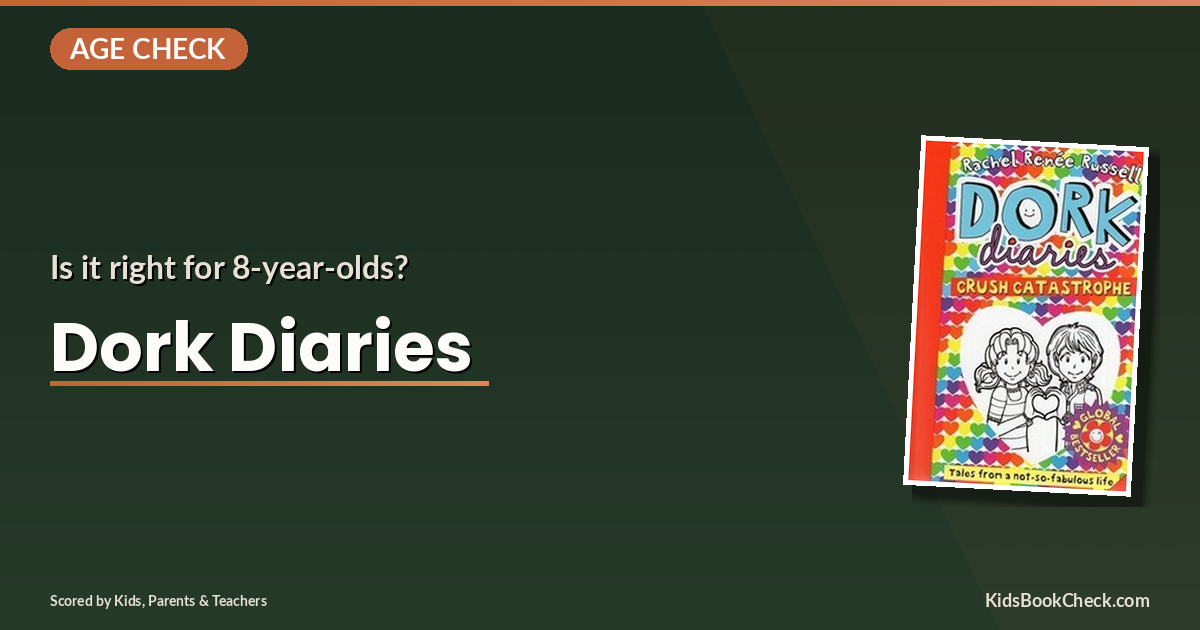
Yes — Dork Diaries is appropriate for 8-year-olds, though it truly shines with kids ages 9 to 12 who are navigating (or about to navigate) the social minefield of middle school. The content is gentle — no violence, no mature themes, no language beyond what you’d hear at a school lunch table. The biggest “concern” is that your child will laugh so hard they forget to do their homework.
What Makes Dork Diaries Irresistible to Kids
Rachel Renée Russell created something sneaky with Dork Diaries: a book that looks like a real diary, reads like a conversation with a best friend, and makes reluctant readers devour 300 pages without realizing they’ve just read a novel. Nikki Maxwell, the 13-year-old protagonist, documents her first-day-at-a-new-school disaster with the kind of dramatic honesty that makes every kid think “that’s exactly how I’d feel.”
KidsBookCheck’s 30-dimension analysis shows the appeal clearly: kids scored this book 75/100, with a near-perfect 9/10 on both Laugh-out-loud humor and First-chapter grab. Those are the scores of a book that hooks kids instantly and keeps them laughing throughout. But parents scored it 54/100, creating a 21-point gap — one of the wider splits in our database. That gap isn’t about content problems. It’s about a fundamental difference in what kids and adults value in a book: kids want to feel understood and entertained, while parents often wish the book was also teaching vocabulary or literary craft. Dork Diaries makes no apologies for choosing entertainment, and it’s exactly why kids trust it.
The Content Parents Actually Worry About
Here’s the honest inventory of everything in Dork Diaries that might give a parent pause:
Social bullying: MacKenzie, the antagonist, is mean to Nikki — excluding her, making comments about her clothes and social status, and generally behaving like a textbook mean girl. This isn’t graphic bullying, and the book treats MacKenzie’s behavior as clearly wrong, but sensitive kids who’ve experienced social exclusion might find some scenes hit close to home.
Here’s the thing about MacKenzie, though: she’s not scary. She’s ridiculous. Nikki’s narration turns every mean moment into comedy — the embarrassment becomes the punchline rather than the wound. A study from the University of Cambridge’s Faculty of Education found that humor-based books about social challenges help children develop resilience strategies by modeling how to reframe negative experiences. That’s exactly what Dork Diaries does, whether intentionally or not.
Appearance and fashion anxiety: Nikki worries about her clothes, her phone (she has a hand-me-down instead of the latest model), and whether she looks right. For image-conscious kids, these passages might amplify existing insecurities rather than soothe them. However, the book’s arc bends firmly toward self-acceptance — Nikki’s art and authenticity win out over status-seeking every time.
What you won’t find: No violence. No scary content. No inappropriate language. No romantic content beyond a mild crush on a boy named Brandon. No mature themes. Dork Diaries is one of the safest middle-grade series on the market in terms of content.
Age-by-Age Breakdown
Age 8: Enjoyable But May Miss Some Nuances
Eight-year-olds can read and enjoy Dork Diaries — the humor is accessible, the illustrations are engaging, and the diary format makes 300 pages feel manageable. However, the social dynamics (cliques, popularity hierarchies, cafeteria politics) are specifically middle-school scenarios. An 8-year-old might laugh at Nikki’s embarrassing moments without fully connecting to the social anxiety that drives them.
That said, many 8-year-olds are already socially aware enough to get it. If your child talks about friend groups, worries about fitting in at school, or has experienced even mild social exclusion, Dork Diaries will feel relevant regardless of their exact grade.
Verdict: Fine to read, though the humor lands harder once your child has their own middle-school experience to compare it to.
Ages 9–11: The Perfect Audience
This is Dork Diaries territory. Nine-to-eleven-year-olds are either in or approaching the social dynamics Nikki describes, and the recognition factor is what makes the book magic. When Nikki writes about the horror of walking into a cafeteria with no one to sit with, kids this age feel it in their bones. The humor becomes a relief valve — proof that someone else has felt exactly this awkward, and survived.
At this age, the book also serves as a quiet conversation opener. Your child might not volunteer “I’m scared about middle school,” but they might say “Nikki’s so funny when she’s worried about lunchtime” — and that’s the same thing in kid language.
Verdict: Peak Dork Diaries age. Hand it over and expect to buy the sequels.
Ages 12–13: Still Fun, Starting to Outgrow
Twelve-and thirteen-year-olds who are already deep into middle school can still enjoy Dork Diaries as comfort reading, but some may find the humor and social situations feel a bit young compared to their actual experience. The plot predictability (new girl finds her people) becomes more obvious to older readers. That’s not a criticism — it means the book did its job at the right time.
Verdict: No concerns. Great comfort read; natural to outgrow.
Reading Level Data
| Measure | Dork Diaries: Tales from a Not-So-Fabulous Life |
|---|---|
| Lexile | 750L |
| AR Level | 4.2 |
| DRA Level | 50 |
| Grade Level | Grades 3–5 |
| Difficulty | Easy |
| Page Count | 304 |
| Format | Diary-format novel with heavy B&W cartoon illustrations |
| Word Count | ~45,000 |
Don’t let the 304-page count intimidate you — the heavy illustration density means the actual reading load is closer to a 180-page traditional chapter book. The diary format breaks text into short, digestible entries rather than continuous prose, and the illustrations appear on nearly every page. For reluctant readers, this is the critical difference between a book that feels achievable and one that feels like homework.
Comparison With Similar Diary-Format Series
| Book | Format | Lexile | AR Level | Age Range | Kid Score | Parent Score | Key Appeal |
|---|---|---|---|---|---|---|---|
| Dork Diaries | Diary + illustrations | 750L | 4.2 | 9–12 | 75 | 54 | Kid-driven (21pt gap) |
| Diary of a Wimpy Kid | Diary + illustrations | 950L | 5.2 | 8–12 | 80 | 47 | Kid-driven (33pt gap) |
| Big Nate | Diary + illustrations | 730L | 3.9 | 8–11 | — | — | Humor-driven |
| Tom Gates | Diary + illustrations | — | — | 8–12 | — | — | UK humor style |
The obvious comparison is Diary of a Wimpy Kid, and here’s what the data reveals: Dork Diaries has a smaller kid-parent gap (21 points vs. 33), meaning parents rate it slightly higher than Wimpy Kid. That’s because Dork Diaries’ social-emotional themes (friendship, self-acceptance, belonging) resonate with parents more than Wimpy Kid’s pure comedy. Meanwhile, kids score both books comparably high. If your child loved Wimpy Kid and wants something similar but with a female protagonist and more heart, Dork Diaries is the natural next pick.
The Diary Format Advantage
Here’s what reading researchers know that parents often don’t: diary-format books are among the most effective tools for building reading habits in reluctant readers. The short entries create natural stopping points (reducing “I can’t finish a chapter” anxiety), the illustrations provide visual anchoring for struggling decoders, and the first-person voice creates an intimacy that third-person narration can’t match.
KidsBookCheck teachers scored Dork Diaries 9/10 on Reluctant Reader Rescue — matching it with Magic Tree House as one of the highest-rated series for turning non-readers into readers. If your child “doesn’t like reading,” handing them Dork Diaries before any literary classic is probably the smarter move. You can introduce Charlotte’s Web after they’ve learned that books can feel like a friend talking to them.
Reading Together: Conversation Starters
Dork Diaries touches on topics most parents want to discuss but don’t know how to bring up:
About social pressure: Nikki obsesses over having the wrong phone and the wrong clothes. Ask your child: “Do you ever feel like you need certain things to fit in at school? What happens when you don’t have them?” This opens the door to conversations about materialism and self-worth without lecturing.
About mean behavior: After encountering MacKenzie, ask: “Why do you think MacKenzie acts the way she does? Do you think she’s happy?” This shifts the conversation from “bullying is bad” (which kids already know) to empathy and understanding motivations — a more sophisticated and useful skill.
About being yourself: Nikki’s art becomes her identity and her strength. Ask: “What’s your version of Nikki’s art? What’s the thing about you that makes you you, even if it’s not what the popular kids care about?” This is a powerful question for kids approaching middle school.
The Bottom Line
Dork Diaries earns its 75/100 kid score by doing one thing brilliantly: making kids feel seen. Nikki Maxwell’s diary isn’t a literary masterpiece, and it doesn’t pretend to be. It’s a funny, honest, illustrated conversation about the scariest thing in a kid’s world — being the new kid, being different, and wondering if anyone will ever get you. The 54/100 parent score reflects limited literary and educational depth, not content problems — this is the safest middle-grade series you’ll find.
For 8-year-olds specifically, it’s a perfectly fine read that gets better with age. If your child is already socially aware and enjoys humor, hand it over now. If they’re still in the golden age of not caring what anyone thinks, save it for 9 or 10 — it’ll land harder when middle-school anxiety kicks in. See our complete 30-dimension analysis of Dork Diaries for the full breakdown of kid, parent, and teacher scores.
Some kids will recognize themselves in Nikki immediately — the anxiety, the overthinking, the desperate wish to just be normal. Others will laugh at Nikki’s disasters from a comfortable distance, entertained but not personally affected. Whether Dork Diaries becomes your child’s comfort book or just a fun afternoon read depends on their social world right now. Take our reader profile quiz and we’ll tell you whether Dork Diaries is the perfect match — or whether a different funny series fits where your kid is today.
Frequently Asked Questions
Is Dork Diaries appropriate for 8-year-olds?
Yes — Dork Diaries contains no violence, mature themes, or inappropriate language. The content is safe for 8-year-olds, though the middle-school social dynamics resonate most with ages 9 to 12. Eight-year-olds will enjoy the humor and illustrations; the social themes land harder once your child has their own school-friendship experiences to compare.
What reading level is Dork Diaries?
Dork Diaries has a Lexile of 750L, an AR level of 4.2, and a DRA of 50, targeting grades 3 to 5 for independent reading. Despite the 304-page count, heavy illustrations and diary-entry formatting mean the actual reading load is closer to a 180-page traditional chapter book — much less intimidating than it looks on the shelf.
Is Dork Diaries like Diary of a Wimpy Kid?
Yes — both use diary-format narration with cartoon illustrations and humor-driven plots about school life. Dork Diaries features a female protagonist (Nikki Maxwell) navigating middle-school social dynamics, while Wimpy Kid follows Greg Heffley through broader comedic situations. KidsBookCheck data shows Dork Diaries has slightly higher parent scores (54 vs 47) due to stronger social-emotional themes.
How many Dork Diaries books are there?
The Dork Diaries series includes 16+ main books plus several companion volumes and holiday specials. New books continue to be published regularly. Each book can be enjoyed independently, though reading in order provides a richer understanding of Nikki’s evolving friendships and social growth throughout middle school.
Is there bullying in Dork Diaries?
Dork Diaries depicts social bullying through the character MacKenzie, who excludes Nikki and makes mean comments about her clothes and social status. The bullying is not graphic or physical — it’s social exclusion and verbal meanness, treated as clearly wrong within the story. Nikki’s humor turns embarrassing moments into comedy rather than trauma, modeling resilience for young readers.
What age should kids stop reading Dork Diaries?
There’s no age where kids need to stop — reading should be enjoyable at every level. That said, most kids naturally outgrow Dork Diaries around ages 12 to 13 as the humor and social situations start feeling young compared to their real experiences. When they’re ready for something with more complexity, consider Keeper of the Lost Cities or Wings of Fire for fantasy, or Dear Martin for realistic fiction with more depth.