Is Big Nate Appropriate for 7-Year-Olds? The Perfect Bridge to Chapter Books
Is Big Nate right for your 7-year-old? KidsBookCheck scores across 30 dimensions reveal the confidence-vs-attitude debate parents need to understand.
The Verdict
Big Nate is a humor bridge book designed for kids transitioning from picture books to chapter books, especially reluctant readers. KidsBookCheck’s composite score is 70.4, with a notable 12-point gap between kid enthusiasm (76) and parent comfort (64). Kids find Nate hilarious and relatable; parents worry about his confidence bordering on arrogance and his disrespect toward authority. Teachers rate it at 72—they see the engagement value and the reading motivation it creates.
Big Nate is absolutely appropriate for most 7-year-olds, particularly if they’re strong early readers or reluctant readers who need engagement. Nate is confident, obnoxious, funny, and he doesn’t apologize—which is either a feature (kids love his bravado) or a concern (parents worry it models bad behavior). The comic-strip format with illustrations means even weak readers feel successful. The humor is silly and accessible without being patronizing.
If your 7-year-old is reluctant to read, this is your book. If your 7-year-old worries about being too rude or aggressive, they might identify too much with Nate’s attitude. Either way, it’s age-appropriate—just different depending on your child.
KidsBookCheck Scorecard
| Category | Score | Notes |
|---|---|---|
| Kid Appeal | 76 | Humor, illustrations, confident protagonist, school setting |
| Parent Comfort | 64 | Attitude, disrespect, confidence that borders on meanness |
| Teacher Recommendation | 72 | Engagement, reading motivation, graphic-novel format |
| Composite Score | 70.4 | Recommended age 7-8+; especially for reluctant readers |
How KidsBookCheck Rates Reluctant-Reader Books
When kids rate significantly higher than parents, it often signals engagement vs. content concern. Big Nate is a perfect example: it’s extraordinarily effective at getting kids reading, but it requires parents to accept a protagonist with attitude. Learn how we evaluate books across different audiences.
Reading Level Details
Big Nate is specifically designed as a bridge from picture books to chapter books, with illustrations occupying roughly 40-50% of each page:
| Metric | Level | Grade Band |
|---|---|---|
| Lexile Score | 370-460L (varies by title) | Grades 2-3 |
| AR (Accelerated Reader) | GN330L-460L | Early reader graphic novel |
| Grade Reading Level | 2-3 | Early elementary independent reader |
| Recommended Reading Age | 7-10 | Perfect for emerging readers; engaging for strong readers too |
The key feature of Big Nate: the illustrations carry half the story. You’re not reading pure text; you’re reading image + text together. This format makes Big Nate accessible to kids who can’t yet handle 250-page chapter books, while the humor keeps sophisticated readers entertained. It’s the rare book that works for both reluctant readers and confident readers.
Age-by-Age Breakdown
Ages 6-7: The Entry Point
Big Nate is perfect for beginning second grade readers. The graphic-novel format is motivating (kids see lots of white space and illustrations, which feels less intimidating than a wall of text). The vocabulary is accessible but not babyish. The humor—joke-based, silly, sometimes groan-worthy—lands immediately with this age group.
Best case: A 6-7 year old who’s hesitant about chapter books discovers Big Nate, reads it in one sitting, and asks for the next book. Motivation crisis solved.
Concern case: A 7-year-old who’s already anxious about behavior sees Nate getting away with disrespect and wonders if that’s allowed.
Ages 7-8: The Sweet Spot
This is Big Nate’s bread-and-butter audience. Most second and third graders can read it independently. The humor is sophisticated enough that they don’t feel talked down to, but accessible enough that they get the jokes without explanation. Nate’s world feels like their world (school, annoying teachers, best friends, crushes). This age group keeps Big Nate flying off shelves.
Ages 9-10: The Extended Appeal
Older kids who’ve read the whole series might graduate to Diary of a Wimpy Kid (more complex, longer form) or Wings of Fire (more fantasy, less humor). But many 9-10 year olds still enjoy rereading Big Nate books, and the series is extensive (16+ books), so there’s always something new to discover.
Parent Concerns: The Honest Debate
”Nate Is Disrespectful to Teachers and Adults. Doesn’t This Model Bad Behavior?”
The truth: Yes, Nate talks back. He’s dismissive of authority. He cheats on tests (sort of). He’s disrespectful to his dad. Some parents see this as modeling terrible behavior.
The counter-truth: Nate never succeeds through disrespect. When he talks back, he gets detention. When he tries to cheat, it backfires. When he disrespects adults, there are consequences. He’s not being rewarded for bad behavior; he’s experiencing natural consequences.
The real distinction: Nate is confident in a way that reads as obnoxious to adults but feels like liberation to kids. He doesn’t apologize for being himself. That’s different from teaching disrespect—it’s teaching self-acceptance. If your child is already anxious about being “too much,” Big Nate might actually be healthy (permission to exist as they are). If your child is already pushing boundaries, Big Nate might feel like permission to push more.
Know your child: That determines whether this is a feature or a bug.
”Nate Is Kind of Mean Sometimes”
True. Nate makes fun of his classmates. He has a somewhat cynical attitude. He’s not the nicest protagonist in children’s literature. But he’s also loyal to his friends and comes through when people need him. He’s real—not a saint, not a villain, just a kid with a big personality.
In comparison: Nate is less mean than Greg Heffley (Diary of a Wimpy Kid), equal to other realistic school-based characters, and way less mean than actual middle-school kids. KidsBookCheck doesn’t expect fictional kids to be perfect angels.
”But He’s So Confident He’s Kind of Annoying”
Yep. That’s the point. Lincoln Peirce is writing about a kid who is genuinely annoying sometimes, and that’s realistic. Not every protagonist needs to be humble and self-aware. Sometimes kids are obnoxious, and that’s okay to write about. Nate’s confidence is part of his charm—kids recognize that confidence in themselves and in their peers.
Comparison Table: Similar Books
| Book | Lexile | Age Range | Similarities | Key Difference |
|---|---|---|---|---|
| Diary of a Wimpy Kid (Greg Heffley) | 650L | 8-12 | Humor, school setting, graphic novel format, boy protagonist | DOAWK is longer, more complex emotionally, Greg is more anxious |
| Dog Man (Dav Pilkey) | 400L | 6-10 | Comic-strip format, silly humor, illustrated heavily | Dog Man is more absurdist, less school-based |
| Captain Underpants (Dav Pilkey) | 590L | 6-11 | Humor-first approach, illustrations, early reader friendly | Captain Underpants is sillier, less grounded in reality |
Why compare? These books all bridge picture books to chapter books, but differently. Big Nate is the most realistic and school-focused. Dog Man is the silliest. DOAWK is the most emotionally complex. Your child’s preference indicates what they need.
The Series Factor
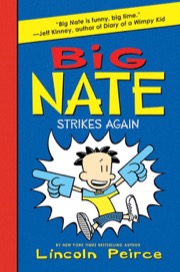
Big Nate isn’t a standalone. Lincoln Peirce has written 16+ books in the series: Big Nate in the House, Big Nate Strikes Again, Big Nate on a Roll, Big Nate Goes for Broke (where our rating comes from), and many more. Plus a spinoff series with a graphic novel format.
Translation: If your 7-year-old gets hooked on Big Nate, you’ve unlocked years of reading motivation. That’s either your favorite thing (endless series to keep them reading) or your nightmare (you’ll buy Big Nate books forever). Most parents choose to see it as a win.
A Parent Empathy Moment
Here’s what we hear from parents of reluctant readers: “We tried everything—rewards, different books, bribes—and nothing worked until Big Nate. Suddenly, he wanted to read. He wanted the next book. He got mad when we made him stop reading to go to bed.”
That transformation—from “I don’t like reading” to “I can’t put this down”—is worth more than perfect behavioral modeling. If Big Nate is the gateway drug to lifelong reading, the attitude issue becomes secondary.
It’s also worth naming: Nate’s confidence is appealing because real kids don’t get to be that brazen. Most kids are worried about fitting in, being too loud, being too much. Nate doesn’t worry. He just is. Some kids need permission to exist that way—not to be mean, but to take up space unapologetically. That’s an underrated gift.
FAQ
Is Big Nate a graphic novel or a chapter book?
It’s a hybrid. It’s written as a novel (prose narrative) but illustrated on roughly 40-50% of each page with comic-style illustrations. Not as heavily illustrated as Dog Man, not as text-heavy as Diary of a Wimpy Kid. Perfect middle ground.
How many words per page?
Varies depending on the page (more illustration = fewer words), but roughly 150-300 words per page. Compare that to a pure chapter book (500+ words per page), and you see why this feels accessible to early readers.
What if my child is already a strong reader at 7?
Big Nate might feel too easy, but don’t dismiss it. Strong early readers often love Big Nate because the humor is sophisticated, even if the reading level is low. It’s perfect for a 7-year-old reading at a 5th-grade level. Quick reads = motivation to read more. Volume builds stamina.
Should I let my child read this if they’re struggling with respect/attitude?
This is genuinely judgment call territory. If your child is already testing boundaries and disrespecting adults, Big Nate might feel like permission to escalate. If your child is overthinking and anxious, Big Nate might give healthy permission to be imperfect. You know your child better than any review. Preview it first if you’re unsure.
How does Big Nate compare to Diary of a Wimpy Kid?
Big Nate is funnier, less emotionally complex, more confident, and more school-focused. Greg Heffley (DOAWK protagonist) is more anxious and more self-aware. Both are excellent. Big Nate is lighter; DOAWK has more depth. For struggling 7-year-olds, Big Nate. For confident 8-9 year olds, either.
Is there a movie?
Yes—a Big Nate movie aired on Nickelodeon (2016) and is available on various platforms. It’s faithful to the book’s spirit while adding more action. Some kids watch the movie first and want to read the books; others read and then watch. Either direction works. The movie increases engagement.
What comes after Big Nate?
Once kids finish the series (or get bored), natural progressions are: Diary of a Wimpy Kid (more complex, more emotional), Wings of Fire (more fantasy/adventure), Percy Jackson (more mythology), or Keeper of the Lost Cities (more worldbuilding). It’s a stepping stone, not a dead end.
Why is the parent score lower than kid and teacher scores?
Parents are concerned about the attitude/disrespect modeling. Kids are entertained. Teachers see the reading motivation and engagement, which they value. All three perspectives are valid—it’s just a gap that needs honest discussion.
What KidsBookCheck Readers Are Saying
“My son hated reading until Big Nate. He’s now devoured the entire series and asking for more. I’ll take the attitude concern if it means he’s a reader now.” — Marcus, parent
“Big Nate feels like permission to be myself. Nate doesn’t apologize for being loud and funny. That helped me.” — Sophie, 8-year-old reader
“Teaching second grade, I always have Big Nate in the classroom library. Kids who resist other books will pick this up. It’s a motivation miracle.” — Ms. Rodriguez, teacher
“Not every book has to have a perfect character. Big Nate is funny and real. Kids deserve that.” — James, parent of a reluctant reader
Ready to Start?
Next step: Take our quick quiz to see if Big Nate fits your child’s reading style and personality, or jump to the Big Nate book page for series order and reading guides.
Ready to read? Grab the first book on Amazon, support Bookshop.org, or borrow from your library. Fair warning: once they start, they’ll want the whole series.
KidsBookCheck’s perspective: The best book for your child is the one they’ll actually read. If Big Nate gets your 7-year-old reading (attitudes and all), you’ve won.
Related Reading
- Best Books for Reluctant Readers Age 7-10
- Comic Novels and Graphic Hybrids for Kids
- How We Rate Books
- Books That Build Reading Confidence
- Chapter Books for Beginning Readers
<!-- JSON-LD Schema Markup -->
<script type="application/ld+json">
{
  "@context": "https://schema.org",
  "@graph": [
    {
      "@type": "Article",
      "headline": "Is Big Nate Appropriate for 7-Year-Olds? The Perfect Bridge to Chapter Books",
      "description": "Lincoln Peirce's Big Nate analyzed: Kid 76, Parent 64, Teacher 72. Confidence vs attitude debate. Why reluctant readers love this series.",
      "image": "/images/blog/is-big-nate-appropriate-for-7-year-olds.png",
      "datePublished": "2026-03-25",
      "dateModified": "2026-03-25",
      "author": {
        "@type": "Organization",
        "name": "KidsBookCheck Team"
      },
      "publisher": {
        "@type": "Organization",
        "name": "KidsBookCheck",
        "logo": {
          "@type": "ImageObject",
          "url": "https://kidsbookcheck.com/logo.png"
        }
      }
    },
    {
      "@type": "Book",
      "name": "Big Nate: Goes for Broke",
      "author": {
        "@type": "Person",
        "name": "Lincoln Peirce"
      },
      "isbn": "0061944343",
      "bookFormat": "Hardcover",
      "numberOfPages": 240
    },
    {
      "@type": "Review",
      "itemReviewed": {
        "@type": "Book",
        "name": "Big Nate: Goes for Broke"
      },
      "reviewRating": {
        "@type": "Rating",
        "ratingValue": "70.4",
        "bestRating": "100",
        "worstRating": "1"
      },
      "author": {
        "@type": "Organization",
        "name": "KidsBookCheck"
      }
    },
    {
      "@type": "FAQPage",
      "mainEntity": [
        {
          "@type": "Question",
          "name": "Is Big Nate a graphic novel or a chapter book?",
          "acceptedAnswer": {
            "@type": "Answer",
            "text": "It's a hybrid—a novel with comic-style illustrations on 40-50% of each page. Perfect bridge between picture books and chapter books."
          }
        },
        {
          "@type": "Question",
          "name": "Should I let my child read this if they're struggling with respect?",
          "acceptedAnswer": {
            "@type": "Answer",
            "text": "This depends on your child. Nate models confidence, not disrespect—but he does have attitude. Preview it first if you're concerned."
          }
        }
      ]
    },
    {
      "@type": "BreadcrumbList",
      "itemListElement": [
        {
          "@type": "ListItem",
          "position": 1,
          "name": "Home",
          "item": "https://kidsbookcheck.com"
        },
        {
          "@type": "ListItem",
          "position": 2,
          "name": "Blog",
          "item": "https://kidsbookcheck.com/blog"
        },
        {
          "@type": "ListItem",
          "position": 3,
          "name": "Age Check",
          "item": "https://kidsbookcheck.com/blog"
        },
        {
          "@type": "ListItem",
          "position": 4,
          "name": "Is Big Nate Appropriate for 7-Year-Olds?",
          "item": "https://kidsbookcheck.com/blog/is-big-nate-appropriate-for-7-year-olds"
        }
      ]
    }
  ]
}
</script>