How to Start a Family Book Club
Practical guide with data-backed book recommendations from KidsBookCheck's 30-dimension rating system. Expert tips for every parent. Trusted picks. Trusted pick
The Quick Answer
A family book club isn’t about literary analysis—it’s about creating a reason to sit together and talk about things that matter. Start with a book your child chooses, meet twice monthly for 30 minutes, use KBC’s built-in discussion guides to spark genuine conversation, and watch your family develop a shared language around stories. The magic isn’t in the reading; it’s in the talking that happens because you’ve read the same book.
Why Family Book Clubs Work (When Everything Else Feels Rushed)
Family life is fractured. Everyone’s on a different schedule, looking at different screens, pursuing different interests. A family book club creates a scheduled, low-pressure reason to sit together. No performance. No scores. Just shared stories and the conversations they spark.
The unexpected benefit: kids say things in book discussions that they wouldn’t say directly. A character’s fear of failure opens the door for your child to admit their anxiety. A character’s friendship struggle becomes permission to talk about what’s happening at school. Books become the bridge to deeper family conversation.
A Parent Empathy Moment #1: You Don’t Have to Love Reading
Some parents love books; some tolerate them. If you’re in the second camp, a family book club might feel like homework. It’s not. You’re not reading to model literary sophistication. You’re reading to create a container for connection.
Even if you listen to the audiobook while doing dishes, you’re part of the club. Even if you only skim the KBC discussion guide before the meeting, you’re contributing. Perfection isn’t the goal—presence is.
Step 1: Choose the Right Book (Let Your Child Lead)
This is the most important decision, and it’s not yours to make alone.
The KBC Selection Framework
-
Check the age range – Use KBC’s age recommendations. Charlotte’s Web is best at 7-10, not 4-6 (too slow) and not 13+ (too young for their interests).
-
Review the Kid score vs. Parent score – For family book club, aim for books where the Kid score is within 10 points of the Parent score. You both need to find it engaging. (This is different from reluctant reader selection, where you want a high Kid score differential.)
-
Look at the themes – Read the “content profile” section in the rating. Does this book handle topics your family is ready to discuss? Death (Charlotte’s Web)? Disability (El Deafo)? Friendship challenges (Amulet)?
-
Check discussion guide availability – KBC includes discussion guides in every rating. These are gold for family book clubs; they give you natural question starters.
Books That Excel for Family Book Clubs
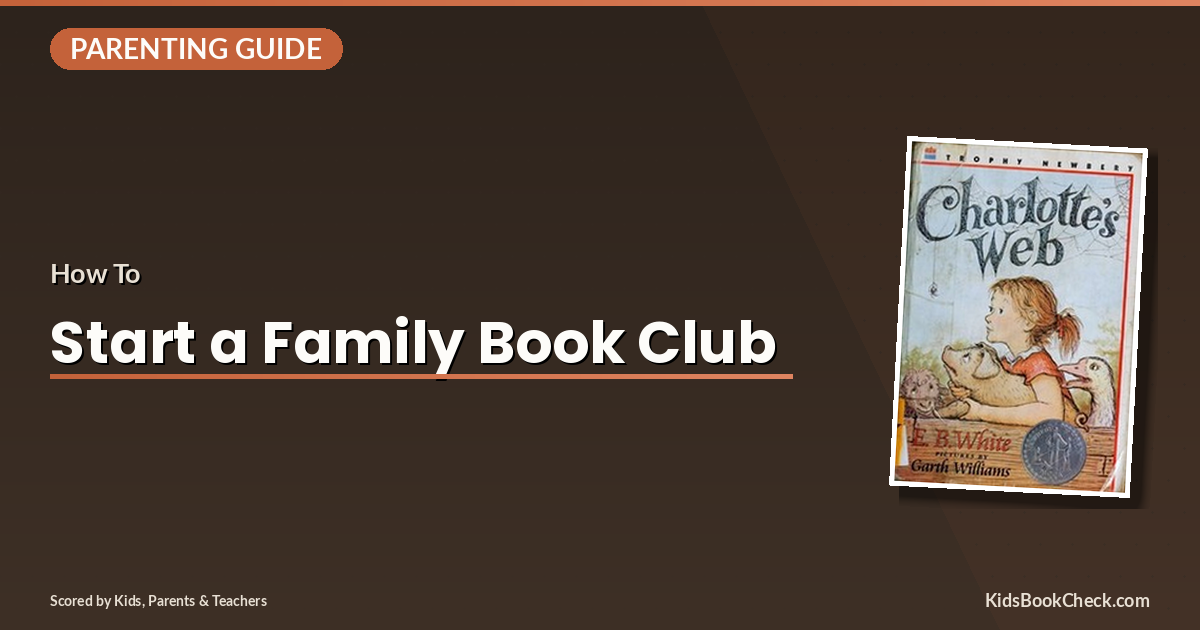
Charlotte’s Web (Ages 7-10)
- Kid Score: 64
- Parent Score: 83
- Why for book club? The ending naturally sparks conversation about friendship, sacrifice, and mortality. Parents love the prose; kids engage with the emotional journey. Mixed-age families find shared ground here.
- KBC Discussion Prompts: Why does Charlotte help Wilbur? What makes something a miracle? What does friendship require?
Wonder (Ages 9-12)
- Multi-perspective narrative makes natural discussion: “What did you think of the story from Daisy’s viewpoint?” Different family members will emphasize different parts, creating rich conversation.
- Themes: Kindness, acceptance, disability, social hierarchy
- Sweet Spot: Works across ages 8-14 with genuine discussion at every age
The Giver (Ages 10-12)
- Controlled world with philosophical questions naturally generate debate: “Would you choose safety or freedom?” Family members will genuinely disagree, creating authentic discussion.
- Themes: Conformity, choice, individuality, loss
- Sweet Spot: Best with older elementary or early middle school where abstract thinking is developing
Amulet: The Stonekeeper (Ages 9-11)
- Graphic novel that engages all readers, including reluctant ones
- Themes: Responsibility, family separation, power and corruption, growing up
- Sweet Spot: Works for visual learners and advanced readers simultaneously
Step 2: Establish Your Book Club Format
The 30-Minute Model (Most Realistic)
Duration: 30 minutes, twice monthly
Structure:
-
Minutes 1-5: Opening conversation (no discussion guide yet—just chat)
- “What was your favorite part?”
- “What surprised you?”
- “Which character would you be?”
-
Minutes 6-20: Guided discussion using KBC prompts
- Start with pre-reading questions
- Move to during-reading questions
- Reserve post-reading questions for later meetings as you progress
-
Minutes 21-30: Personal connections
- “Does this remind you of anything in our lives?”
- “What would you do differently than this character?”
- “Who else would you recommend this book to and why?”
Advance Preparation (Minimal)
- Parent/guardian: Skim the KBC discussion guide the night before
- Children: Just read their chapter/section; no prep required
- Meeting: Bring the book + discussion guide (can be printed or on phone)
That’s it. This isn’t a homework club.
A Parent Empathy Moment #2: Your Child Might Say “This Book Is Boring”
Some books just don’t land for specific kids, no matter how well-reviewed. If your child is genuinely disengaged after 2-3 chapters, switch books. Family book club should create bonding, not resentment.
If you’re two chapters in and your child loves it but you’re bored, push through—but choose your next book with your preferences in mind. You’re both allowed preferences.
Step 3: Use KBC Discussion Guides Strategically
Every KBC rating includes a structured discussion guide with questions organized by reading stage (pre-reading, during-reading sections, post-reading). Here’s how to use it without it feeling like a school assignment:
Pre-Reading Questions (Before You Start)
These create context and activate prior knowledge. Example from Charlotte’s Web:
- “Have you ever had a friend who was very different from you? What made that friendship work?”
- “What do you know about spiders? Do you think a spider could ever be a hero in a story?”
These aren’t about being “right”—they’re about warming up your child’s brain for the book.
During-Reading Questions (As You Progress)
KBC guides organize these by chapter sections. Example from Charlotte’s Web (Chapters 1-5):
- “Why does Fern think it’s unfair to kill the runt pig? Do you agree with her?”
- “How does Wilbur feel about his new home in the barn?”
Don’t ask all questions. Pick 1-2 that genuinely interest you. The guide is a menu, not a checklist.
Post-Reading Questions (After Completion)
These are your richest discussion territory. Example from Charlotte’s Web:
- “Charlotte says helping Wilbur was a way to ‘lift up my life a trifle.’ What does she mean by that? Can helping others change how you feel about your own life?”
- “Why do you think E.B. White connects friendship and writing?” (Final line: Charlotte was “a true friend and a good writer.”)
These questions often generate 10+ minutes of genuine conversation because they require thinking, not just comprehension.
Step 4: Create Family Book Club Rituals
Rituals make the practice sustainable. Small consistent actions matter more than elaborate setups.
Physical Ritual
- Same location – Kitchen table, living room corner, wherever feels natural
- Same time – Saturday morning with hot chocolate, Tuesday evening after dinner—consistency matters
- Visual signal – Light a candle, use special mugs, arrange cushions. Small signals that “this is book club time”
Speaking Ritual
- Each person gets uninterrupted speaking time – When your 10-year-old is talking, no jumping in to correct or expand. Let them finish.
- “I disagree because…” not “You’re wrong” – Model civil discourse. When someone says “I think the character made a good choice,” another person can say “I disagree because I think she should have…” This is practice in respectful debate.
- No wrong answers about feelings – “What did you think of Wilbur?” has many valid answers. Respect each.
Celebration Ritual
- Small celebration when you finish a book: dessert, game, outing
- Not a big reward (that makes books feel like work), just acknowledgment: “We did it! We finished Charlotte’s Web together.”
Managing Mixed Ages (The Real Challenge)
If your family has ages 8-12, you’ll have different reading levels, different interest levels, and different processing speeds. This is actually valuable.
Strategies for Age Diversity
1. Graphic novels bridge the gap
- Older/stronger readers still find them engaging
- Younger/weaker readers can access them independently
- Everyone reads the same book successfully
- Example: Amulet works for 8-year-old strong readers and 12-year-old reluctant readers simultaneously
2. Read aloud the first chapters together
- Younger children hear fluent reading and get hooked by the story
- Older children follow along and engage with the narrative
- Everyone then reads independently at their pace
- Family book club discussion happens when everyone’s finished
3. Let older kids lead discussion
- “What did you think about when Wilbur first met Charlotte?”
- Older children have more sophisticated thoughts; let them articulate them
- Younger children learn from listening and get permission to have simpler thoughts
4. Ask different questions based on age
Younger child (8-9): “Which character would you be? Why?”
Older child (11-12): “Why do you think the author chose to end the book this way rather than differently?”
Same book, developmentally appropriate discussion.
The Unexpected Benefits (Beyond Reading Improvement)
Family Language Around Emotions
After reading Charlotte’s Web, when your child is worried about dying or leaving friends, they might say: “I’m feeling like Wilbur when Charlotte left.” Now you have a book-language shortcut to deep conversations.
Conflict Resolution Tool
Reading about characters’ conflicts gives you a neutral place to talk about your family’s conflicts. “How would you handle what Fone Bone did in that situation?”
Discovering Your Child’s Values
Book discussions reveal what your child actually cares about. You might think they only care about video games until they passionately argue that a character did the right thing by sacrificing. Now you know something true about them.
Modeling Thoughtful Disagreement
Your child argues the character made the right choice; you disagree. You don’t resolve it. You sit with the ambiguity. This teaches that smart people can disagree thoughtfully—invaluable life skill.
Frequently Asked Questions
Q: What if we choose a book and my child refuses to read it?
Stop. Pick a different book. A family book club book needs buy-in from readers, not just adults. Go back to your child and say: “You’re right, that one doesn’t sound fun. What would you want to read instead?”
Q: Can we do audiobook + physical book, mixed?
Absolutely. Some family members listen while driving; others follow along in the printed book. Some read chapters independently, then listen together. The format mix is fine as long as everyone experiences the same story.
Q: How long should we commit to this?
Try 8 weeks (about 2-3 books). That’s enough to establish the rhythm and see if it’s working. After 8 weeks, assess: Are people looking forward to book club? Are conversations genuine? If yes, continue. If no, pause without guilt. You tried something good.
Q: What if our family’s reading speeds are very different?
Set a “finish by” date rather than a strict reading schedule. “Everyone read chapters 1-4 by Saturday for our meeting.” Some people read it in one sitting; others spread it across the week. Both are fine.
Q: Should we make reading notes or do written responses?
No. This creates school-assignment vibes. Talk is the point. If someone wants to jot notes while reading, fine, but don’t require it.
Q: Can we skip months?
Yes. Family book club is flexible. “We’ll take a break in December and restart in January” is fine. Consistency matters, but so does sustainability.
Internal Links
- Take the KidsBookCheck Quiz to Find Your Family’s First Book Club Book
- Best Books for Family Discussion: Ages 8-12
- How KidsBookCheck Ratings Help You Choose Books
- Graphic Novels for Family Reading
- Chapter Books That Spark Conversation
Citation
Mem Fox’s “Reading Magic: Why Reading Aloud to Our Children Will Change Their Lives Forever” emphasizes the bonding and language development that occurs through shared reading experiences, noting that family book clubs create what she calls “reading aloud moments” that deepen family relationships while building literacy skills.